Tuesday, October 22, 2024

Veterans for Trump: The Death of Honor

Canvassing in York County today I said hello to a veteran wearing a cap with Vietnam service and campaign ribbons.  Since my canvassing list was only democrats, I assumed he was a Republican. I said hello because we were the only two people outside for as far as I could see on the very straight street.

We talked civilly for a few minutes. He told me he enlisted in the Army reserve in 1970, served six years in the United States and left the military.  "I should've stayed," he said.  I told him I enlisted in 1972 and served until 1985, getting out and re-enlisting twice, then re-enlisted once more in 2007 and went to Iraq.  

I told him I never got closer to Vietnam than Utah during the war.  He made clear he was a Vietnam-era veteran.  

Shortly after he asked if I lived in the neighborhood. I said no. I live in Lancaster and was canvassing for Janelle Stelson for Congress. He said, "Don't try to tell me to vote for a democrat! I'll never vote for a democrat."

I told him I was only going to democrats and just said hello because we were both veterans.  He then went from smoldering anger (I assume a usual state given his demeanor.) to lecture mode.  "Stelson doesn't live here. Perry does. I'm voting for Perry. And Harris let in all those migrants. The country is overrun."

I waved and wished him a nice day.  "We won't have a country if Harris wins. Too woke!" he said to my back.  

When I told another veteran about the encounter he knew right away what was wrong.  Both of us served during the Vietnam War but not in the war. We are careful to say that.  The grumpy veteran's hat said something very different. It says Vietnam service.  Of course, inflating one's service record is as common as fisherman talking about "the one that got away." When I was first in the military, lying was stunning.

For me, another effect of Trump was to make draft dodging and this sort of mendacity normal. Fifty years ago, that veteran would have been ashamed to claim war service. Honor would have prevented him.  

Dishonor is the default when a bragging coward like Trump is the head of a party.  

In 2016 I saw draft dodgers become defiant now that they had a coward who bragged about draft dodging as their leader. 

Sunday, October 20, 2024

Canvassing Empty Streets and Sidewalks: No One is Outside


In six weeks of canvassing, I have knocked on a thousand doors in cities and suburbs across south central Pennsylvania.  I walked empty streets and sidewalks between those houses.  

Empty.

It was not the weather. I canvas in the daytime. Generally the temperature was between high 60s and mid 70s. Wonderful weather.  

No kids. No walkers. No runners. No bicyclists. Just the occasional driver with windows closed of course.  

Is it social media?  I can't tell, but it seems like a good explanation.  I spend two or three hours in neighborhood.  If anyone was going to walk, run, ride, play games, sit on the porch or something else outside the house, I am likely to have seen them.  

Some of the houses I canvas have kids in the family. They peek out of the windows when I ring the bell or cling to mom's leg while she talks to me. But I have not seen kids outside.  

A couple of times as I walked down sunlit empty streets I thought "The Last of Us" and other dystopian stories.  Whole neighborhoods with no sign of life. 

My Exceptional Neighborhood

By contrast, my own neighborhood in Lancaster city has walkers, runners, cyclists, people that sit outside, kids, dog walkers and other signs of live community. If there is a social media plague keeping everyone inside, I'm glad I live in a place with social media antibodies.  

I'll be knocking on doors until the election; I will definitely write if I find a neighborhood besides my own with signs of life. 


Friday, October 18, 2024

A Very Complex Story: The Arc of a Covenant: The United States, Israel, and the Fate of the Jewish People by Walter Russell Mead


This book is a history of the relationship between Israel and the United States.  Like so many relationships, the partners look back and rewrite their history as the years recede.  And the more they love each other, they more they tend to rewrite history into rose-tinted myth.  

I knew very well how badly America (and most of the world) acted toward Jews during the Nazi era and the Holocaust. So when I read about America's support for Israel from the first moment after Israel declared itself independent, I was ready to fill in continuous support from 1948 to now.

I was wrong.  

Walter Russell Mead showed me the actual, bumpy complex history of America's support (and not) for Israel.  

Yes. President Harry Truman recognized Israel from the moment of its founding, but he did it on condition that he get to recognize Israel before anyone else: 11 minutes after the announcement.

To his credit, Truman believed the Jews had a right to a country of their own.

But. 

Truman also set up an arms embargo on the new nation of Israel.  If the arms embargo had succeeded the Holocaust would have been repeated as six Arab armies invaded Israel. Truman's state department was more concerned about their relationship with the Arab nations than the survival of Israel.

When America let Israel  twist in the wind, a very ironic triangular relationship developed that saved Israel and led to Israel's victory over the invaders.  

Along with the US, the Soviet Union recognized Israel.  The relationship only lasted until 1953, but it was long enough to allow Israel to exist.  

In 1948, the Soviet Union needed hard currency. In February the Soviet Union took over Czechoslovakia in a Coup.  The small country was home to the Skoda works. Skoda made weapons for the Nazi army under Nazi occupation.  They had a massive inventory of German weapons.  

Also in 1948, Israel declared independence in May and future Israel Prime Minister Golda Meir began crisscrossing America raising money for the fledgling state of Israel.  That money could have bought  tons of surplus America weapons consigned to destruction, but the embargo prevented that purchase.

Instead, the money flowed back to Israel and from there to Skoda and to the Soviet Union.  When Israeli representatives visited the Skoda factory, they were delighted to find tons of weapons at bargain prices. It was also made clear that the Soviet Union was ready to circumvent the American arms embargo--for cash.

American money paid for surplus German weapons which were then smuggled by Soviets around an American embargo. Those weapons allowed Israel to defeat six Arab armies and exist as a nation.  

America continued to ignore Israel until 1967.  After the huge victory in the Six Day War, Israel suddenly looked like a regional power and America became friendly.  The new warmth was timely because the French, Israel's principle arms supplier in the 1950s and early 60s, were backing away from Israel because of internal politics.  

With the Soviets openly arming the Arabs, America started selling arms to Israel.  The relationship between the US and Israel became closer after the 1973 Arab-Israeli War.  But the first actual treaty between the two countries was made by President Ronald Reagan in 1987, almost 40 years after Israeli independence.  

The book is full of insights about the relationship between the US and Israel which I did not get from the many histories of Israel I have read.

It's an interesting book for anyone who wants to know about the complex history of the US/Israel relationship.  

Tuesday, October 15, 2024

Signs of the Times: As I Canvass for Candidates I See the Parties in their Signs


Recently, I was canvassing on a lovely day in a suburban Philadelphia district divided very closely between left and right. The houses I visited were all in a township that has a "No Solicitation" law. Violations can result in a fine of $375-$1,000. 

A few of the "No Solicitation" houses had a black box near that door that announced "You are under video surveillance" as I approached. One woman opened the door to ask, "Did you not understand the no solicitation sign?"  I replied that the law does not cover free speech including political speech. She shut the door.

It did not affect my canvassing because political and religious solicitation is exempt. 

I passed many houses with signs for democratic candidates and others with signs for republican candidates.

The only houses I passed with "No Solicitation" signs posted on the door that were identifiable as one party or the other were Republican. 

Last week I walked past two houses in Lancaster side by side on a city street. Both houses had two signs out front. The first house had a "Harris-Walz" sign and another that said "Love Thy Neighbor." The second had a "Trump-Vance” sign and another that said "No Trespassing."


Sunday, October 13, 2024

War and Peace by Leo Tolstoy: Beauty and Deep Irony Unlocked by Hannah Arendt


Irony can be lovely in literature. The current living master of irony in my reading is Kazuo Ishiguro especially in his book The Remains of the Day. Another sad and beautiful master of irony is Walter Miller Jr. in his book A Canticle for Liebowitz. Miller and Ishiguro intend irony.

Leo Tolstoy did not, but there is more irony at the center of War and Peace than in the biggest Soviet-era Russian steel mill.  The deep love stories that swirl through this beautiful book are set in tragedy a time of war. The story begins in the gossip and whirl of upper class city life and ends with country family life.  

At intervals throughout the book, Tolstoy interrupts the narrative to tell us with increasing stridency that great people, and all people, have no real influence on life and history.  The collective spirit of the people, and chance, and fate, and the will of God guide events.  The great people believe they are in charge, but they are merely corks bobbing on a river flowing where God and nature intend.  

While he is telling us great people have no influence, Tolstoy fills hundreds of pages of this 1,500-page book with the actions of Napoleon, Marshall Kutuzov, Emperor Alexander, as well as mayors, generals and other leaders.  To learn how great people have no influence, we learn a lot about what they do.  

My current reading of War and Peace was on a Kindle in the translation by Pevear and Volokhonsky.  In the late 80s I read the Constance Garnett standard translation.  In 2000, I read the Almyer and Louise Maude translation.    

Since 2000, I have gone to war and after returning from that war read all of the works of Hannah Arendt.  The year in Iraq showed me how deeply Tolstoy was affected by his service in the War in Crimea and how he turned that experience into art.  Reading Arendt showed me why I disagreed so completely with the philosophy that fills hundreds of pages of Tolstoy's longest novel.  

Central to Hannah Arendt's view of the human condition is natality.  She says that each person when born has the potential to influence the world.  Each new life is a new beginning.  Further, in her book titled The Human Condition Arendt divides human activity into Labor, Work and Action.  Labor is work done that leaves no trace--factory work, cleaning, cooking.  Work is creating things that endure--furniture, works of art, jewelry.  Action is influencing others.  

When we act, we influence others who have wills and ideas of their own, so we never know what will come of our words.  Leaders persuade people to act but the message strikes each individual in a different way. So what seems a mass from the outside is really individuals, each moved in their own way by the message. In fact some may hear the message and become opponents while others follow. 

Natality, in Arendt's description, brings unique possibilities into the world in the life of every individual.  After reading Arendt, reading Tolstoy's philosophy gave me the same feeling I have when reading Sam Harris and other determinists.  I understand why they believe what they do, but cannot agree.  Natality gives me billions of reasons to know that something new could come into the world begin by one person and change the world, for good or ill.   

In the first epilogue of War and Peace Tolstoy says his book is not a novel.  It's his book, so he can say whatever he wants.  But the story itself is wonderful on its own terms.  The philosophy underneath it does not affect the intricate beauty of the story Tolstoy tells.  If I read it again, I will skip the philosophy and enjoy the story.


Friday, October 11, 2024

The Declaration of Independence

Thomas Jefferson. The sole author of 
the most influential document in the history of the world.

The Declaration of Independence 

In Congress, July 4, 1776


The unanimous Declaration of the thirteen united States of America, When in the Course of human events, it becomes necessary for one people to dissolve the political bands which have connected them with another, and to assume among the powers of the earth, the separate and equal station to which the Laws of Nature and of Nature's God entitle them, a decent respect to the opinions of mankind requires that they should declare the causes which impel them to the separation.


We hold these truths to be self-evident, that all men are created equal, that they are endowed by their Creator with certain unalienable Rights, that among these are Life, Liberty and the pursuit of Happiness.--That to secure these rights, Governments are instituted among Men, deriving their just powers from the consent of the governed, --That whenever any Form of Government becomes destructive of these ends, it is the Right of the People to alter or to abolish it, and to institute new Government, laying its foundation on such principles and organizing its powers in such form, as to them shall seem most likely to effect their Safety and Happiness. Prudence, indeed, will dictate that Governments long established should not be changed for light and transient causes; and accordingly all experience hath shewn, that mankind are more disposed to suffer, while evils are sufferable, than to right themselves by abolishing the forms to which they are accustomed. But when a long train of abuses and usurpations, pursuing invariably the same Object evinces a design to reduce them under absolute Despotism, it is their right, it is their duty, to throw off such Government, and to provide new Guards for their future security.--Such has been the patient sufferance of these Colonies; and such is now the necessity which constrains them to alter their former Systems of Government. The history of the present King of Great Britain is a history of repeated injuries and usurpations, all having in direct object the establishment of an absolute Tyranny over these States. To prove this, let Facts be submitted to a candid world.


He has refused his Assent to Laws, the most wholesome and necessary for the public good.


He has forbidden his Governors to pass Laws of immediate and pressing importance, unless suspended in their operation till his Assent should be obtained; and when so suspended, he has utterly neglected to attend to them.


He has refused to pass other Laws for the accommodation of large districts of people, unless those people would relinquish the right of Representation in the Legislature, a right inestimable to them and formidable to tyrants only.


He has called together legislative bodies at places unusual, uncomfortable, and distant from the depository of their public Records, for the sole purpose of fatiguing them into compliance with his measures.


He has dissolved Representative Houses repeatedly, for opposing with manly firmness his invasions on the rights of the people.


He has refused for a long time, after such dissolutions, to cause others to be elected; whereby the Legislative powers, incapable of Annihilation, have returned to the People at large for their exercise; the State remaining in the mean time exposed to all the dangers of invasion from without, and convulsions within.


He has endeavoured to prevent the population of these States; for that purpose obstructing the Laws for Naturalization of Foreigners; refusing to pass others to encourage their migrations hither, and raising the conditions of new Appropriations of Lands.


He has obstructed the Administration of Justice, by refusing his Assent to Laws for establishing Judiciary powers.


He has made Judges dependent on his Will alone, for the tenure of their offices, and the amount and payment of their salaries.


He has erected a multitude of New Offices, and sent hither swarms of Officers to harrass our people, and eat out their substance.


He has kept among us, in times of peace, Standing Armies without the Consent of our legislatures.


He has affected to render the Military independent of and superior to the Civil power.


He has combined with others to subject us to a jurisdiction foreign to our constitution, and unacknowledged by our laws; giving his Assent to their Acts of pretended Legislation:


For Quartering large bodies of armed troops among us:


For protecting them, by a mock Trial, from punishment for any Murders which they should commit on the Inhabitants of these States:


For cutting off our Trade with all parts of the world:


For imposing Taxes on us without our Consent:


For depriving us in many cases, of the benefits of Trial by Jury:


For transporting us beyond Seas to be tried for pretended offences:


For abolishing the free System of English Laws in a neighbouring Province, establishing therein an Arbitrary government, and enlarging its Boundaries so as to render it at once an example and fit instrument for introducing the same absolute rule into these Colonies:


For taking away our Charters, abolishing our most valuable Laws, and altering fundamentally the Forms of our Governments:


For suspending our own Legislatures, and declaring themselves invested with power to legislate for us in all cases whatsoever.


He has abdicated Government here, by declaring us out of his Protection and waging War against us.


He has plundered our seas, ravaged our Coasts, burnt our towns, and destroyed the lives of our people.


He is at this time transporting large Armies of foreign Mercenaries to compleat the works of death, desolation and tyranny, already begun with circumstances of Cruelty & perfidy scarcely paralleled in the most barbarous ages, and totally unworthy the Head of a civilized nation.


He has constrained our fellow Citizens taken Captive on the high Seas to bear Arms against their Country, to become the executioners of their friends and Brethren, or to fall themselves by their Hands.


He has excited domestic insurrections amongst us, and has endeavoured to bring on the inhabitants of our frontiers, the merciless Indian Savages, whose known rule of warfare, is an undistinguished destruction of all ages, sexes and conditions.


In every stage of these Oppressions We have Petitioned for Redress in the most humble terms: Our repeated Petitions have been answered only by repeated injury. A Prince whose character is thus marked by every act which may define a Tyrant, is unfit to be the ruler of a free people.


Nor have We been wanting in attentions to our Brittish brethren. We have warned them from time to time of attempts by their legislature to extend an unwarrantable jurisdiction over us. We have reminded them of the circumstances of our emigration and settlement here. We have appealed to their native justice and magnanimity, and we have conjured them by the ties of our common kindred to disavow these usurpations, which, would inevitably interrupt our connections and correspondence. They too have been deaf to the voice of justice and of consanguinity. We must, therefore, acquiesce in the necessity, which denounces our Separation, and hold them, as we hold the rest of mankind, Enemies in War, in Peace Friends.


We, therefore, the Representatives of the united States of America, in General Congress, Assembled, appealing to the Supreme Judge of the world for the rectitude of our intentions, do, in the Name, and by Authority of the good People of these Colonies, solemnly publish and declare, That these United Colonies are, and of Right ought to be Free and Independent States; that they are Absolved from all Allegiance to the British Crown, and that all political connection between them and the State of Great Britain, is and ought to be totally dissolved; and that as Free and Independent States, they have full Power to levy War, conclude Peace, contract Alliances, establish Commerce, and to do all other Acts and Things which Independent States may of right do. And for the support of this Declaration, with a firm reliance on the protection of divine Providence, we mutually pledge to each other our Lives, our Fortunes and our sacred Honor.


Saturday, October 5, 2024

When the Invader Intends Only Evil: War is Right


Sam Harris, noted Atheist, Meditation Guru

In the wake of the Hamas attack on Israel on October 7, 2023, the Jewish atheist meditation guru Sam Harris became one of my rabbis.  In the midst of  tragedy, he spoke calmly and sensibly about the situation in Israel and for Jews in the rest of the world.  

The sexual violence and murder of the Hamas attack was followed by worldwide support for the attackers: and complete silence by women's rights groups. The progressive left, especially on college campuses, defended and exalted Hamas.  Black Lives Matter Chicago used a hang glider like those used by Hamas as a symbol of freedom at a rally days after the attack.

In that moment, Sam Harris said the world could choose between Jihad and civilization. We cannot have both.  As long as Hamas, Boko Haram, ISIS, The Iranian regime, the Houthis and Hezbollah exist, civilization is at risk.  

The proper response to Jihadi terror is war.  

In the past few weeks I have spoken to many people who believe war is always wrong. 

I believe they are wrong.  War is the right response implacable evil.  

War against the Nazis and the Death Cult of Imperial Japan was right. War against Jihad until they have no ability to rape and slaughter is right. 

Right now, Israel is the only nation to make the affirmative choice to fight against armies that have vowed in their founding documents to destroy Israel and kill Jews.  If the Jihadis win, the rest of the civilized world is their eventual target.   

Hamas has lost most of its fighters, but refuses to negotiate, preferring death, especially the death of Gazans other than themselves.  The Houthis attack ships to  close the Red Sea to world trade. Iran threatens to build and use a nuclear weapon.  Hezbollah planned another rape and slaughter attack on Israel but was thwarted recently when Israel killed and maimed thousands of Hezbollah leaders in a series of sabotage attacks.   

For those who do not know what real evil sounds like, Sam Harris posted a transcript of a Hamas murderer bragging about the ten Israelis he killed.

--------------------------

Another war of necessity against an evil foe who intends destruction of their nation is The War in Ukraine.  Russia invaded Ukraine to carry out a program of Imperial expansion by Vladimir Putin.  

The majority of Americans support Ukraine seeing it as the front line of  a fight against Russian expansion in Europe.  I have supported the Ukrainians in every way I can since the beginning of the invasion.  

In the strategic sense, Ukraine is defending America as it defends itself.  Russia has lost a million soldiers killed and wounded since the war began.  We have sent only weapons to Ukraine. No American soldiers are fighting and dying in Ukraine, only Ukrainians defend their homeland.

---------------------------

In both wars, if the invaders stop fighting, the wars will end.  If either Israel or Ukraine stops fighting, their nations will cease to exist and their people will be enslaved or killed. 

Every person I spoke to who is against these wars and against all wars said, "Why don't they negotiate?'

Which only makes clear they know nothing of negotiation.  To make a deal, both sides have to have something they will compromise on.

Jihadi terrorists want the destruction of Israel and the death of Jews.  

The ground for compromise is?????

Putin believes Ukraine is not a nation and that he, as ruler of Russia, is the rightful ruler of Ukraine.

The ground for compromise is?????

War, in those circumstances, is right. 


Wednesday, October 2, 2024

The Attraction of Tyrants: Our Default Government is Monarchy


The Dragon Queen, Daenerys Targaryan, Game of Thrones

Whether in real life or fiction, for all of recorded history and before, the default form of government we both lived under and wanted is monarchy--rule by a single, all-knowing, enlightened, benevolent, brilliant, brave person.  (Best case.) It hardly bears mentioning that this ruler is the representative of God on earth and easily confused with the supreme being, especially in the mind of the ruler.  

Which answers the question of why so many people can vote for Trump, especially Christians.  Given every word and the life of Jesus (available in a very popular, apparently little-read book) it may seem crazy to think that people who declare themselves followers of Jesus could believe Trump is God's choice to rule America, but they do.  Catholic, Evangelical, Protestant, Mormon, Adventist--every flavor of Christian and all of their global acolytes love Trump.  

It is no accident that Trump praises tyrants in every speech and promises more and more arbitrary authoritarian actions: mass deportations, shooting shoplifters, travel bans.  His rally audience cheers every tyrannical utterance of their chosen bully. 

Partly, this is because the democracy America brought to the world beginning with the Declaration of Independence, requires constant work and compromise.  We all have to deal with our fellow citizens and live with them as best we can get.  

Trump and every other tyrant promises the return order and justice with no effort. That is the center of their appeal.

Americans after World War II thought our democratic history somehow protected us from the rapid fall into Naziism in Germany and to an Imperial death cult in Japan.  We now know it is possible anywhere. Democratic Germans and Japanese were swept up in a popular wave. Many millions of Americans want tyranny.  Trump is only too happy to grant their wish. 

Queen Daenerys Targaryan began her reign freeing slaves and ended incinerating her subjects.  Granting absolute power to anyone is dangerous.  Granting absolute power to a craven bully like Trump will be a disaster from Day One.


Friday, September 27, 2024

John Fetterman--The Gift That Keeps on Giving to Pennsylvania, America and the Free World

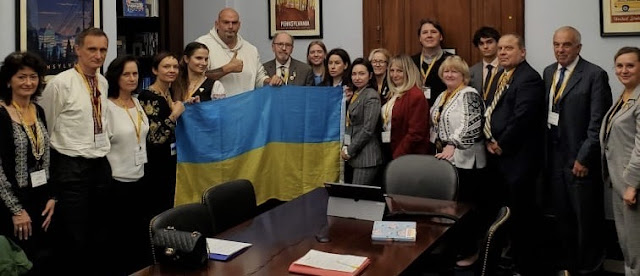
The Pennsylvania delegation at the Ukraine Action Summit visiting Senator John Fetterman

On the second morning of the Ukraine Action Summit in Washington DC, the Pennsylvania delegation visited the office of Senator John Fetterman.  He is unequivocal in his support of Ukraine in its war against Russian invasion and aggression.  

In two days we visited most of the 19 members of the Pennsylvania Congressional Delegation.  Fetterman was the most clear and emphatic in his support, as he has been from the first day of the invasion on February 24, 2022.  

This is the fourth summit I have participated in since October of last year. Each time we visit Fetterman's office, I am revitalized in my work as a political activist.  

Much of the work of political activism shows no obvious results. I have been to many protests and marches where I can see no difference before and after.  But the longest protest I was involved in had the wonderful result of opening the door to Fetterman's election to the Senate.  

From November of 2016 to January of 2023, I was part of an intrepid group who showed up in front of the Philadelphia office of Senator Pat Toomey of Pa., year round in all weather.  In 2016, Toomey promised if elected he would have open town hall meetings in Philadelphia.  We started "Tuesdays with Toomey" to hold him to that promise. In our primary goal, we failed.  Toomey never held an open town hall, anywhere.  

But our protests, at every Toomey office across the state, eventually led Toomey to not seek reelection, nor to seek the governorship.  Will Bunch, the politics correspondent at the Philadelphia Inquirer said "implacable opposition" in part led Toomey to decide not to run.  

In a 50-50 state like Pa., incumbency is a real advantage.  Because Toomey decided not to run, Fetterman did not have to run against an incumbent.  And then (thank you Trump) Fetterman did not have to run against a viable candidate.  Trump's pick, Dr. Oz, was the Republican candidate. Fetterman won!  

Fetterman spoke twice at Tuesdays with Toomey in Philadelphia while he was serving as Lieutenant Governor of Pa.  We were delighted when he ran for the Senate, more delighted that we could in some small way contribute to his victory.  

And our reward is all the Senator John Fetterman has done to support Ukraine.


Thursday, September 26, 2024

Amerika by Franz Kafka


More than 40 years ago, I entered the strange world of Franz Kafka in the usual way: reading "The Metamorphosis."  This strange story of Gregor Samsa who wakes up having turned in a bug (maybe a cockroach) fascinated me. The story begins with the struggles of a big bug in a Vienna household.  Over time his family adapts to his state and eventually continues with their life--the way humans adapt to every sort of horror we face.  

In Amerika, the central character, Karl Rossmann arrives in America, abandoned by his family. He begins a series of  misadventures that are a descent--some of his problems are of his own making through pride and stubbornness, some are bad luck.  But the descent is inexorable.  

The story left me feeling pain, both empathy for Karl and for the author. Kafka's life was short, isolated and miserable.  Below is a New York Times review of the 2009 translation of Amerika, the one I read. It gives much more context than I could.  When I first read Kafka, I thought he would be one of the authors of whom I read all he wrote.  That list includes Hannah Arendt, Mark Helprin, CS Lewis, Kazuo Ishiguro, Bernard-Henri Levy, Leo Tolstoy (fiction) but not Kafka. The pain I feel as I read him makes his books a very occasional read (two in 40 years).

America, ‘Amerika’

By Adam Kirsch

Jan. 2, 2009

Most writers take years to become themselves, to transform their preoccupations and inherited mannerisms into a personal style. For Franz Kafka, who was an exception to so many rules of life and literature, it took a single night. On Sunday, Sept. 22, 1912, the day after Yom Kippur, the 29-year-old Kafka sat down at his desk and wrote “The Judgment,” his first masterpiece, in one all-night session. “Only in this way can writing be done,” he exulted, “only with such coherence, with such a complete opening out of the body and the soul.”


Everyone who reads Kafka reads “The Judgment” and the companion story he wrote less than two months later, “The Metamorphosis.” In those stories, we already find the qualities the world would come to know as “Kafkaesque”: the nonchalant intrusion of the bizarre and horrible into everyday life, the subjection of ordinary people to an inscrutable fate. But readers have never been quite as sure what to make of the third major work Kafka began writing in the fall of 1912 ­— the novel he referred to as “Der Verschollene,” “The Missing Person,” which was published in 1927, three years after his death, by his friend and executor Max Brod, under the title “Amerika.”


The translator Michael Hofmann, whose English version of the book appeared in 1996, correctly called it “the least read, the least written about and the least ‘Kafka’ ” of his three novels. Now Schocken Books, which has been the main publisher of Kafka’s works since the 1930s, hopes to reintroduce his first novel to the world with a new translation, by Mark Harman. “If approached afresh,” Harman promises in his introduction, “this book could bear out the early claim by . . . Brod that ‘precisely this novel . . . will reveal a new way of understanding Kafka.’ ”


Harman offers a compromise between Kafka’s intended title and Brod’s more familiar one by calling his version Amerika: The Missing Person ($25). And he follows previous English editions by retaining the German spelling of America, with a “k.” This lends the name, in American eyes, a more ominous and alien quality than it would have for the German reader. That “k” is hard to resist, however, and not just because readers have come to expect it. No writer has ever annexed a single letter the way Kafka did with “k.” Between the two in his own last name, Joseph K. of “The Trial” and K. of “The Castle,” the letter seems imbued with his own angular essence. Amerika is not America; it is a cipher for Kafka’s dream of a country he never visited.

The difference becomes clear in the very first paragraph, when Karl Rossmann sails into New York Harbor and sees the Statue of Liberty: “The arm with the sword now reached aloft, and about her figure blew the free winds.” The torch of liberty has metamorphosed into a punishing sword, an omen of the many chastisements in store for Kafka’s victim-hero. Indeed, America itself is a punishment for Karl, who was sent there by his parents after he got a servant girl pregnant back home. What Kafka actually writes, however, is that “a servant girl had seduced him,” and when Karl remembers the fatal episode, it is clear he was more the victim than the aggressor: She “shook him, listened to his heart, offered him her breast so that he too could listen but could not induce Karl to do so, pressed her naked belly against his body, searched between his legs with her hand — in such a revolting manner that Karl shook his head and throat out from under the quilts — then pushed her belly up against him several times; it felt as if she were part of him; hence perhaps the terrible helplessness that overcame him.”


Taking into account the fact that Karl is 17 and Johanna, the “girl,” about 35, this sounds less like seduction than rape. And it is a template for the way everyone Karl encounters in “Amerika” will ignore his desires and overpower his will.


In the first chapter, Karl tries to intercede with the ship’s captain on behalf of a stoker who has been mistreated, but his rich American uncle simply waves off his protests. Later, when Karl pays a visit to one of his uncle’s friends, Mr. Pollunder, his uncle treats it as a terrible transgression and cuts him off — even though Karl made sure to get permission beforehand. (This arbitrary rewriting of the rules looks forward to the unwritten laws of “The Trial.”)


While at Pollunder’s house, Karl is nearly raped once again, this time by a teenage wrestler named Klara. (“I won’t stop at one slap,” she threatens, “but shall go on hitting you left and right until your cheeks start swelling.”) When he escapes, he falls in with a couple of tramps, Delamarche and Robinson, who rob and bully him. He becomes an elevator boy at a luxury hotel but gets fired for crimes he didn’t commit. So it goes, humiliation after humiliation, until Karl ends up a virtual slave to Delamarche’s grotesquely obese mistress, the singer Brunelda.


It is enough to make the reader want to ask Karl what he demands of the stoker: “So why don’t you speak out? . . . Why do you put up with everything?” “Amerika” never provides a good answer to this question: Karl is simply helpless, unable to make sense of the world or get along in it. Not until the last chapter, when he finds a job in the enigmatic Theater of Oklahama (Harman preserves Kafka’s misspelling), does Karl seem to find a home in America — and even then, it’s possible that Kafka would have had other torments in store for him, if he had completed the novel.


Karl’s innocence is the main reason “Amerika” remains less persuasive a parable than “The Trial” and “The Castle.” To be sure, in his first novel Kafka lighted instinctively on many of the techniques he would later use to such great effect. So similar are all three novels in structure and mood that they can be seen as the successively widening turns of a spiral; each time, Kafka surveys the same spiritual territory, but from a more commanding height.


But the crucial innovation of the later novels, which makes their dream-worlds so convincingly uncanny, is the way Kafka’s avatars always seem to be colluding in their own punishment. In the first chapter of “The Trial,” when the officers come to arrest Joseph K., he thinks, “If he were to open the door of the next room or even the door leading to the hall, perhaps the two of them would not dare to hinder him.” But he doesn’t make a move to escape, just as, later on, he freely obeys the summons of the court and finally submits to his execution. It is his own sense of guilt, especially sexual guilt, that makes Joseph K. accept his trial.


Karl Rossmann, however, refuses to accept responsibility for his desires, and it is a mark of Kafka’s own immaturity that he allows Karl to be constantly seduced and abused, never to act as seducer or abuser. Compare Karl’s childlike description of sex with K.’s wholly knowing, wholly mutual encounter with Frieda, in “The Castle”: “She sought something and he sought something, in a fury, grimacing, they sought with their heads boring into each other’s breasts; . . . like dogs desperately pawing at the earth they pawed at each other’s bodies.”


Klaus Mann, introducing an edition of “Amerika” in 1946, wrote that Kafka “deeply and simply loves his innocent creature, his favorite dream, his heir,” Karl Rossmann. But it was not until Kafka accepted the guilt of his “creature” and “heir,” and confiscated all but the first letter of Karl’s name as punishment, that he could become the poet of the inexpungible guilt in all of us.


Adam Kirsch is a senior editor at The New Republic and the author of “Benjamin Disraeli.”


Thursday, September 19, 2024

The Concept of History, Chapter 2 of "Between Past and Future" by Hannah Arendt

When we say history is written by the victors, we are assuming or accusing the historians of writing propaganda.  But as Hannah Arendt makes clear in the 2nd chapter of Between Past and Future history began with Homer's impartial view--writing about greatness and courage on both sides of the tragic war that lead to the founding of Rome by the defeated.  

Here is Arendt on impartiality in history in Ancient Greece:

Impartiality, and with it all true historiography, came into the world when Homer decided to sing the deeds of the Trojans no less than those of the Achaeans, and so to praise the glory of Hector no less than the greatness of Achilles. This Homeric impartiality as it is echoed by Herodotus who set out to prevent “the great and wonderful actions of the Greeks and the Barbarians from losing their due meed of glory,” is still the highest type of objectivity we know. Not only does it leave behind the common interest in one's own side and one's own people, which up to our own days characterizes almost all national historiography, but it also discards the alternative of victory or defeat which moderns have felt expresses the “objective” judgment of history itself and does not permit it to interfere with what is judged to be worthy of immortalizing praise. Somewhat later, and most magnificently expressed in Thucydides, there appears in Greek historiography still another powerful element that contributes to historical objectivity. It could come to the foreground only after long experience in polis-life, which to an incredibly large extent consisted of citizens talking with one another. In this incessant talk, the Greeks discovered that the world we have in common is usually regarded from an infinite number of different standpoints, to which correspond to the most diverse points of view. In a sheer inexhaustible flow of arguments, as the sophists presented them to the citizenry of Athens, the Greek learned to exchange his own viewpoint, his own “opinion”—in the way the world appeared and opened up to him δοκει μοι, “it appears to me,” from which comes δοξα, or “opinion”—with those of his fellow citizens. Greeks learn to understand—not to understand one another as individual persons, but to look upon the same world from one another's standpoint, to see the same in very different and frequently opposing aspects. The speeches in which Thucydides makes articulate the standpoints and interests of the warring parties, are still a living testimony to the extraordinary degree of this object activity.

The Concept of History, Chapter 2 of Between Past and Future by Hannah Arendt, pg. 51-2

I wrote about the Preface of Between Past and Future here.


Wednesday, September 18, 2024

Israel: A Simple Guide to the Most Misunderstood Country on Earth


I just finished Israel: A Simple Guide to the Most Misunderstood Country on Earth by Noa Tishby

The title is a promise fulfilled.  I have read a lot of Jewish history and listened to more in the dozens of episodes of "The Jewish Story" by the Rav Mike Feuer. 

Every history is selective, Tishby, by design, has to cram decades into sentences and eras into paragraph.  I like what she chose. Particularly, her description of the destruction of Jerusalem by the Romans in AD 70 showed how complex that disaster was.  When she describes everything the Jews did inside the walls to provoke the Romans and lose the conflict, the disaster seems inevitable.  

On the rise of Ultra Orthodox culture in Israel, she notes that their tradition and weird black hat uniform dress is a product of a 17th Century Eastern European subculture, nothing to do with Torah.  

The book was published before October 7, 2023, so it does not include the slaughter of innocents by Hamas terrorists. In a speech six months after the tragic events, Tishby was very clear in her views.

The speech us below.  I recommend this book as a brief, lucid history of Israel.  

----

This is the most challenging speech I’ve ever delivered, but it’s time the world wakes up to what the Jewish community has been saying all along. What we experienced on and since October 7 was sadly, predictable. We’ve warned of the danger of radical Islam or, more accurately, the radical Islamic Nazism that is constantly lurking at Israel’s borders. And we’ve warned of the ongoing grooming of Western civilization – through universities, the media, and social media. We warned what the phrase “from the river to the sea Palestine will be free” really looks like. It means “itbach al Yahud” – “slaughter the Jews.” This demonization of Israel is not “progressive”, it’s not peaceful and it absolutely won’t Free Palestine. It is a modern-day blood libel calculated to incite, pave the way for, and then justify - a genocide. We’ve seen it for over three and a half thousand years of Jewish “lived experience”. It’s the generational trauma that is in our bones. We understand it. That, is our “Jewish privilege.” We knew where it would lead, and we are devastated to be proven right. Israel is one of the greatest stories ever told and its vilification is one of the greatest smear campaigns in the history of the world. But we have news for you: when we say Never Again, we mean it. When you tell us you want to kill us, we believe you. And when you set out to do it in the most horrific of ways, we will defeat you. We stand shoulder to shoulder with the families of Israelis and Americans held hostage by the Hamas terrorists and demand they return the hostages now! Bring them home! Above all I am grateful that for the generations to come, the Jewish people will still live, love, and thrive and reach out a hand to the world. And Hamas will be nothing but a footnote in history, just like those who tried to exterminate us before. Am Yisrael Chai 🇮🇱


Friday, September 13, 2024

Marking Major Anniversaries


9-11 Memorial NYC


One reason for marking fateful days in history is to remember how much the world has changed in your own lifetime.
Fifteen years ago today, 11 September 2009, I was a soldier on a one-year deployment to the Iraq War with the US Army.
Fifteen years before that, in 1994, I was a civilian still not quite believing the Soviet Union had collapsed in 1991.
Fifteen years before that in 1979, I was tank commander on the East-West border in Germany waiting for the Soviet invasion of that never happened.


Fifteen years before that I was an 11-year-old 5th grader at Robin Hood Elementary School in Stoneham, Massachusetts. Our school was a fallout shelter. Nuclear war was a shadow on life during the Cold War.
The world has changed a lot in some ways, and not at all in others.
In just over a week, I will be advocating for Ukraine in the US Congress. Russia invaded. The attack I was waiting for for the first four decades of my life happened in Ukraine.
Huge changes, some sad consistency.
Glory to Ukraine!


Sunday, September 8, 2024

Icons on Ammo Boxes: Seven Galleries Show Ukrainian Art at NYC Art Week Preview


On September 4, on the eve of the beginning of  Art Week in NYC, I went to a gallery in Chelsea for the Volta Art Fair. Dozens of galleries exhibiting and thousands of works of art on display.  Seven of the galleries featured art by Ukrainians, both in Ukraine and from the Ukrainian diaspora.  

On gallery featured several Orthodox icons painted on ammo crates.  I saw the icons just passing and then looked closer at the one on the right in the photo above and noticed latches that are used on NATO machine gun ammo crates.  Ukrainian soldiers create these icons.  It was a lovely display of faith expressed in art in a country invaded by a tyrant.


Below are a sampling of what was on display by Ukrainian artists.


And one more icon


Tuesday, September 3, 2024

Quoting Hannah Arendt: Not Easy, but No Excuse for Fake Quotes


On Friday, 6 September, the Virtual Reading Group of the Hannah Arendt Center at Bard College, will begin the discussion of "Between Past and Future" first published in 1961. 

Recently, Roger Berkowitz, founder and academic direct of the HAC, wrote an excellent essay about the problem of made up quotes of Hannah Arendt and by extension all authors.  He is right. Read it here

Last month an insightful essay on this book was published on the HAC site.  It begins with a quote from Arendt's preface to the work that I marked as "theme" in the margin.  Here is the essay by Mark Aloysius, S.J.

The opening quote on the essay shows why quoting Arendt can be so difficult.  The 70-word sentence has three independent clauses, with three dependent clauses. Reading this sentence made me glad I am old enough to have diagrammed sentences in elementary school. The quote is an entirely appropriate opening for an essay on the HAC web site, but not the kind of thing that would get likes on TikTok or Snapchat. 

Here is the quote:

Seen from the viewpoint of man, who always lives in the interval between past and future, time is not a continuum, a flow of uninterrupted succession; it is broken in the middle, at the point where ‘he’ stands; and ‘his’ standpoint is not the present as we usually understand it but rather a gap in time which ‘his’ constant fighting, ‘his’ making a stand against past and future, keeps in existence.”
(Hannah Arendt, Between Past and Future: Eight Exercises in Political Thought. Edited by Jerome Kohn. New York: Penguin Books, 10).

One of my many reasons for being a member of the HAC is the discussions that guide the reading of Arendt's complex thought.  After reading Arendt's preface, I transcribed the paragraph that the above quote is in. The 263-word paragraph has just five sentences. One is a simple16-word sentence quoting William Faulkner.  The other four have 60, 36, 70 and 81 words.  

The relatively snappy 36-word sentence has two dependent clauses.  The closing 81-word sentence has two independent clauses and four dependent clauses.  Arendt was not writing for social media.  

In a decade and a half of reading Arendt, the former ad writer in me has never found her quotable, but I have been able to discuss with enthusiasm what she has said with people who care about the human condition (to make a pun) in all of its complexity.

Here is the paragraph I transcribed:

"The first thing to be noticed is that not only the future—“the wave of the future”—but also the past is seen as a force, and not, as in nearly all our metaphors, as a burden man has to shoulder of whose dead weight the living can or even must get rid of in their march into the future. In the words of Faulkner, “The past is never dead. It is not even the past.” This past, moreover, reaching all the way back into the origin, does not pull back but presses forward, and it is, contrary to what one would expect, the future which drives us back into the past.  Seen from the viewpoint of man, who always lives in the interval between past and future, time is not a  continuum, a flow of uninterrupted succession; it's broken in the middle, at the point where “he” stands; and “his” standpoint is not the present as we usually understand it but rather a gap in time which “his” constant fighting, “his” making a stand against past and future, keeps in existence.  Only because man is inserted into time, and only to the extent that he stands his ground does the flow of indifferent time break up into tenses; it is this insertion—the beginning of a beginning, to put it in Augustinian terms—which splits up the time continuum into forces which then, because they are focused on the particle of the body which gives them their direction, begin fighting with each other and acting upon man in the way Kafka describes."


Friday, August 30, 2024

The (Pot)Hole Story -- Panama is a tough place to ride


First Week in Panama--The Daily Downpour

I bought a bike the first full day I was in Panama.  The bike is great. I wrote about it here.    


I quickly got good at dodging the rain. The weather app in my phone that is so reliable in America, is rubbish here. It says it will rain when the sun is shining and it will be cloudy when rain is falling in sheets.   

Rain I could handle.  But the farther I ride, the more I have to contend with potholes.  On a descent a few miles from the city, I hit a hole so deep it flatted the tire and tore a hole in it.  I wrote about that here.  

And the holes deep enough to flatten a tire are everywhere.  It's not so bad riding uphill, but downhill, I have to scan for holes the whole way! I'm riding the brakes and very focused--not having fun feeling the wind.  It's surely safer to roll down hills on high alert hands on the brake hoods, but it's not fun. 

On the way up the hills, the holes are no problem, but even riding the white stripe at the edge of the tarmac, buses and trucks have to move around me.  One the main roads in and out of the city, there are no shoulders.  

When there are shoulders, another hazard appears at random--sewers without covers.  Some of these uncovered drains are big enough to swallow a whole wheel, not just flat a tire.  I told a local guy about this. He shrugged and said people steal the covers and sell them for the metal.  When there is a shoulder, I ride just off the roadway and scan for the uncovered drain.  

I've been riding every day here, but my rides are getting shorter and are on roads where I have memorized the holes and know the hazards.  On Labor Day I will return to the US until mid November.  

When I return, I will have Gatorskin tires and be looking for weekend groups to ride with.  Right now, I'm feeling like the cocodrillo in the photo below is waiting in holes on every road here.


Monday, August 26, 2024

Why the West Rules — For Now: A Review by The New York Times


Why the West Rules — For Now: The Patterns of History, and What They Reveal About the Future

by Ian Morris 

A friend recommended I read "Why the West Rules--For Now" and I was delighted with this long history of the entire world.  This is my kind of book, so I was predisposed to like it. Other books in this genre I love:

  • Sapiens, Yuval Harari
  • Guns, Germs and Steel, Jared Diamond
  • Civilization: The West and the Rest, Niall Ferguson
  • These Truths,  Jill Lepore
  • Prisoners of Geography, Tim Marshall

A one-volume history of all or part of the history of the world is ambition incarnate. When a historian can assert: Here is the history of the world (or a large slice of it) and make a good case, it is both interesting and opens a hundred interesting questions.  

Ian Morris writes about the history of the East and the West in parallel. At the time the book was published they looked to be converging. A decade and a half later the West retained economic leadership, but the world is much more fragmented and dangerous than in 2010.  

I am going to read more of Morris starting with "Foragers, Farmers and Fossil Fuels" published in 2015.  I have read at least one other book by all the other authors in my  list above, but the one in the list is my favorite, so far.   

---------

"The Final Conflict" a review by Orville Schell

Dec. 10, 2010

This is a big “big book.” To accomplish his ambitious goal of both understanding the evolution of mankind’s past development and prognosticating the future of the continuing East-West horse race, Ian Morris starts around 15 millenniums ago. That’s a lot of history.

With such a grand design, “Why the West Rules — For Now” suggests the pretension of those Imperial Chinese encyclopedists who produced works like the Qing dynasty’s “Complete Collection of Illustrations and Writings From the Earliest to Current Times,” which sought to document “everything under heaven” in its 800,000 pages. It is hardly surprising that China, which has recently stolen up behind the “developed world” to threaten its supremacy (and all its common wisdom about development models), sits at the center of Morris’s book.

A British-born archaeologist, classicist and historian now at Stanford University, Morris is the historians’ equivalent of those physicists who search for a still elusive unified field theory. In his new book, he sets out to discover broad patterns, “the overall ‘shape’ of history,” by sifting through the world’s long development process. Following the oscillating forces from prehistory to the present, he shows how both the East and West managed to catalyze themselves at different times and in different ways to progressively new heights of development. But his ultimate challenge is to make sense of all these cycles of rise and fall, the better to judge whether either side was in possession of any innate superiority. His answer to that question is an emphatic no. East and West, he tells us, are just “geographical labels, not value judgments.”

If neither East nor West has had any innate developmental advantage, what then allowed the West to propel itself forward so successfully in the 18th century (answer: the discovery of fossil fuels), and what does that dominance portend for the future? “One of the reasons people care about why the West rules,” Morris explains, “is that they want to know whether, how long and in what ways this will continue — that is, what will happen next. . . . How long the West will stay on top is a burning question.”

But before you get to the answer, you must be ready to steel yourself for Morris’s early chapters, which nonspecialists will no doubt find arcane. His discussions of primitive man’s common African gene pool; of how the “Hilly Flanks” in the Middle East developed after the Ice Age; and of China’s ancient Zhou dynasty can seem awfully remote. And as he visits ancient places like Urartu, Erlitou, Tenochtitlán, Uluburun and Yue; introduces us to individuals like Hoshea, Tiglath-Pileser III, Khusrau II, Merneptah and Zhu Xi; or sets us down among the Ahhiyawans, Xiongnu, Kizzuwatnans, Hurrians and Jur­chens, your head may begin to spin.

However, just as you begin to wobble beneath the breadth of such impressive research, Morris will pull back and give a brief coda of down-to-earth clarification, rescuing those readers with the will to soldier on through a few more millenniums. Or he will drop in a welcome wry aside to goad you down the trail of history. Commenting on the Ming dynasty explorer Zheng He, he notes that Zheng “was enlisted in the emperor’s service and castrated,” but nonetheless “seems to have taken all this in his enormous stride.” Or, on the discovery of the Americas, he observes, “Europe got a new continent and Native Americans got smallpox.”

Fortunately, Morris is a lucid thinker and a fine writer. He uses a minimum of academic jargon and is possessed of a welcome sense of humor that helps him guide us through this grand game of history as if he were an erudite sportscaster. He shows us how different empires were boosted by periods of “axial thought” to surge up the development ladder, only to crumble upon hitting a “hard ceiling,” usually inflicted by what he calls the Five Horsemen of the Apocalypse: climate change, migration, famine, epidemic and state failure.

But failure of one civilization only allowed another to arise somewhere else. The Roman Empire, Song dynasty China, Renaissance Europe and the Britain of the Industrial Revolution came along, got lift under their wings from new technology, social innovation or a creative organizing principle and pushed the whole process of development forward another notch.

According to Morris’s scorecard, since this age-old process began, the world index of social development has risen to 900 points. And, he predicts, in the next 100 years this index will rise an additional 4,000 points. He calls such progress “staggering.”

But with the West’s power and confidence now declining, and China’s authoritarian form of capitalism ripsawing its way toward an ever more dominant position in the world, a reader may be forgiven for becoming somewhat impatient. Is Morris ever going to answer the “burning question”? Who will win the next phase of our East-West horse race, the United States or China?

Finally, Morris surprises us. He duly acknowledges that “patterns established in the past suggest that the shift of wealth and power from West to East is inexorable” and that we may even be moving from “bankrupt America to thriving China.” But what really concerns him, it turns out, is not whether the West may be bested by the East, but whether mankind’s Promethean collective developmental abilities may not end up being our common undoing.

The competition that East and West have been pursuing for so long, Morris warns, is about to be disrupted by some powerful forces. Nuclear proliferation, population growth, global epidemics and climate change are in the process of radically altering old historical patterns. “We are approaching the greatest discontinuity in history,” he says.

Sounding suddenly more like an admonishing preacher than the amiable sportscaster to whom we have grown accustomed, Morris counsels that we now need to concentrate not on the old competition between East and West, but on a choice. We must decide between what Morris, borrowing from the writer Ray Kurzweil, terms “the Singularity,” salvation through the expansion of our collective technological abilities, and “Nightfall,” an apocalypse from the old Five Horsemen aided by their new accomplices. He warns that this choice offers “no silver medal.” One alternative “will win and one will lose.” We are, he insists, “approaching a new hard ceiling” and are facing a completely new kind of collective historical turning point.

For the Singularity to win out, “everything has to go right,” Morris says. “For Nightfall to win only one thing needs to go wrong. The odds look bad.”

Because distinctions of geography are becoming increasingly irrelevant, Morris views the old saw that “East is East and West is West” as a catastrophic way of looking at our present situation. Like it or not, East and West are now in a common mess, and “the next 40 years will be the most important in history.”

Although he implies it everywhere, Morris does not explicitly call for the United States and China to find new ways to collaborate. There may be no other solution. But will the leaders of these two unpredictable countries be able to rise to the unprecedented challenge they face? Not even Morris’s polymathic research abilities and pathbreaking analytic skills can help us answer that . . . for now.

------

Illustrated. 750 pp. Farrar, Straus & Giroux. $35

Orville Schell, the Arthur Ross director of the Center on U.S.-China Relations at the Asia Society, is writing a historical interpretation of China’s economic boom.

A version of this article appears in print on Dec. 12, 2010, Page 19 of the Sunday Book Review with the headline: The Final Conflict. 

Destined for War: Ancient Greece and the Shadow Over the Twenty-First Century

  A friend with deep connections in China recommended Graham Allison 's Destined for War after President Xi Jinping warned President T...