Showing posts with label math. Show all posts

Saturday, May 16, 2026

A Most Elegant Equation: Euler's Formula and the Beauty of Mathematics by David Stipp: The Joy of Understanding!


A Most Elegant Equation by David Stipp is a small book about a large idea: that mathematics, at its deepest level, is not a collection of separate tools but a unified language capable of describing the universe with astonishing precision. Centered on Euler’s identity—often called the most beautiful equation in mathematics—the book shows how seemingly unrelated parts of math come together in a single, elegant statement.

As someone whose formal math education stopped at Calculus II, I found the book both accessible and intriguing. It does not require advanced training to appreciate the central insight: that numbers, functions, and constants that appear to belong to entirely different domains—imaginary numbers, exponential growth, circular motion—can be woven together into a relationship that is both exact and profound. The equation itself feels almost like a coincidence at first glance, but the book patiently reveals the deeper structure behind it.

What makes the book especially compelling is its ability to convey why this matters beyond mathematics. The same abstract relationships that produce Euler’s identity also underlie the physical world—waves, oscillations, and the geometry of space. It is a reminder that mathematics is not just invented, but discovered, uncovering patterns that seem to exist independent of us.

At times, the explanations push the edge of what a non-specialist can easily follow, and some readers may find themselves rereading sections to fully grasp the connections. But that effort is part of the experience. The reward is a clearer sense of how disparate ideas—real and imaginary numbers, algebra and geometry—fit together into a coherent whole.

In the end, A Most Elegant Equation succeeds not by teaching advanced mathematics, but by revealing its unity. It leaves the reader with a renewed sense of wonder at how something so abstract can so precisely describe the world we live in.


Sunday, January 9, 2022

First Book of 2022: Unflattening by Nick Sousanis


My first book of 2022 was in the category graphic novel. But the book in question is not a novel. It is a philosophy book that is written with words and drawings.  

But graphic novel is the category according to Wikipedia, so I will go with it:

graphic novel is a book made up of comics content. Although the word "novel" normally refers to long fictional works, the term "graphic novel" is applied broadly and includes fiction, non-fiction, and anthologized work. It is, at least in the United States, typically distinct from the term "comic book", which is generally used for comics periodicals and trade paperbacks.

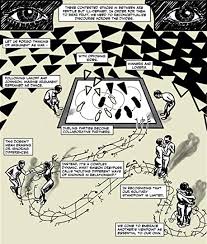
Before I read Unflattening, I heard Nick Sousanis talk about how his book came to be and what he was trying to do with his use of graphics.  I loved hearing him talk about how our eyes follow images and graphical cues and how he used that knowledge to create the book.

I liked this review by comicsgrid.com

Over eight chapters, Unflattening follows an anonymous, sleepwalking figure as they step out of a regimented life and take flight to explore new worlds. Sousanis draws the imagery of these worlds from TV, movies, the classical canon of art, and scientific diagrams. Unflattening embraces visual references from Paleolithic cave prints to James Bond films, and verbal ones from Bruno Latour to Wallace Stevens. The protagonist bears at one time Hermes’ sandals and at others wings of its own; it is incarnated as a Pinocchio-like puppet confounded by a centipede’s existential challenge, ‘Who are you?’, before finally being reborn as a child reminiscent of Kubrick’s 2001: A Space Odyssey (1968). The comic’s final image is of that newborn’s eye opening to see the world as if for the first time.

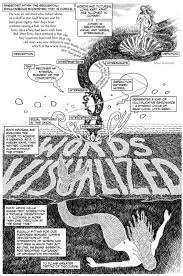
In the course of this journey, Sousanis dethrones the primacy of the word in a kind of Copernican revolution. He argues that image is not mere illustration, subordinate to words, but an equal partner and component in thinking. He explores stereoscopic vision and the principles of astronomical observation as metaphors in order to define ‘unflattening’ as ‘a simultaneous engagement of multiple vantage points from which to engender new ways of seeing.’ (Sousanis 2015: 32).

An extended sequence takes us through the world of Edwin Abbott’s Flatland, in which two-dimensional ‘A. Square’ encounters a three-dimensional sphere who exposes him to previously unimagined perspectives. We need each other’s points of view, Sousanis tells us, to avoid become constrained in set modes of thinking and blinkered perspectives, just as A. Square must be enlightened by his encounter with the sphere. Words and images together free us from the limitations presented by either the purely visual or purely verbal. 

And here are a few pages.  


I hesitated to read the book for a long time, but now I am reading two other graphic novels (both biographies of scientists).  Unflattening will take your mind places it has never been before.

Enjoy!

My books of 2021:

Fiction

Non fiction 

Favorite

Books of 2022

A Most Elegant Equation: Euler's Formula and the Beauty of Mathematics by David Stipp: The Joy of Understanding!

  A Most Elegant Equation by David Stipp  is a small book about a large idea: that mathematics, at its deepest level, is not a collection o...