Phillips Payson O’Brien’s The Strategists is ostensibly a study of five wartime leaders—Franklin Roosevelt, Winston Churchill, Adolf Hitler, Joseph Stalin, and Benito Mussolini—but beneath its military history lies a fascinating argument about character. These men possessed enormous power over the greatest war in history, and the ways they exercised that power cannot be separated from the people they had become long before 1939.
One of the book’s vivid patterns is childhood. With the important exception of Roosevelt, O’Brien’s subjects experienced childhoods marked by serious rejection, deprivation, or violence, even by the standards of their era. Churchill suffered emotional rejection and verbal abuse. Hitler, Stalin, and Mussolini grew up amid poverty and violence; the latter three were themselves brutal and troublesome young men. O’Brien does not offer childhood trauma as a simple explanation for dictatorship. But these early experiences help illuminate the extraordinary insecurity, vanity, aggression, and need for dominance that later characterized several of these leaders.
Roosevelt stands apart. Born to privilege and raised in a secure environment, he possessed plenty of vanity and self-confidence, but his confidence did not require him to be right about everything. That distinction becomes enormously important. Roosevelt could change his mind, tolerate competing advisers, and adopt new technologies and strategies. His great strategic insight was that the United States should exploit its immense industrial power rather than fight the kind of war its enemies expected.
Churchill, despite a profoundly different personality, shared some of this flexibility. Both men understood that the Second World War would not simply be a larger version of the First. Air and sea power could destroy enemy production, transportation, shipping, and fuel supplies while Allied industry created forces the Axis could never match. Roosevelt especially understood that American factories, aircraft, ships, and logistical networks were themselves weapons of war.
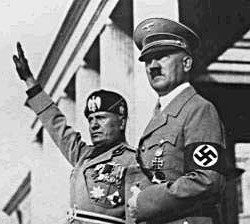
Hitler and Mussolini were far less adaptable. Both remained intellectually trapped in the First World War. Mussolini emerges as particularly inadequate to the responsibilities he had assumed. He wanted greatness without possessing either the military resources or strategic judgment required to achieve it. Worse, he was extraordinarily sensitive to what he imagined to be the will and enthusiasm of the Italian people. Strategy became theater. Decisions that should have depended upon industrial capacity, logistics, geography, and military reality instead depended upon prestige and emotion.
Hitler’s failure was different and ultimately far more destructive. Early victories reinforced his conviction in his own genius. When his decisions succeeded, the successes proved his superiority. When they failed, the failures did not disprove it: generals, allies, weather, inadequate will, or betrayal were responsible. As Germany’s military position deteriorated, Hitler became not more flexible but more certain. Reality increasingly had to conform to Hitler rather than Hitler adapting to reality.
Stalin presents the most complicated case. His prewar brutality and catastrophic purges had badly damaged the Soviet state and military. Yet the existential crisis created by the German invasion forced him to adapt. He learned to rely more heavily on competent commanders and to make decisions based upon military necessity. For a time, survival disciplined Stalin. Once Soviet victory became increasingly certain, however, the old Stalin reemerged. Success reduced the necessity for flexibility.
This is where O’Brien’s portraits acquire implications far beyond biography. The personalities of five individuals helped determine where armies marched, which weapons were built, how economies were organized, and ultimately whether millions of people lived or died. Character became strategy, and strategy became history.
The contrast is especially striking because arrogance was hardly confined to the dictators. Roosevelt and Churchill could be vain, stubborn, and badly wrong. The crucial difference was not that democratic leaders always made better decisions. It was that they remained capable of recognizing new realities and changing course.
That fits the larger argument running through O’Brien’s work. Modern war is not ultimately decided by heroic battlefield gestures alone. It depends upon production, technology, transportation, fuel, shipping, aircraft, and the ability to replace what has been destroyed. Roosevelt and Churchill increasingly grasped this. Hitler and Mussolini never fully did.
Perhaps the most profound lesson of The Strategists is therefore not about World War II at all. Great power magnifies character. An insecure man’s vanity can become a nation’s strategy; an inability to admit error can become an army’s catastrophe. Conversely, curiosity, adaptability, and the willingness to listen can become strategic assets as consequential as battleships and bombers.
O’Brien shows us five enormously powerful men confronting the same global catastrophe. Their circumstances mattered. Their economies mattered. Their armed forces mattered. But so did something much harder to quantify: who they were when the moment came to decide.