Showing posts with label Museum. Show all posts

Thursday, February 12, 2026

Musée Marmottan Monet: History, Collection, and Serene Beauty

Image

 Tucked away in Paris's 16th arrondissement, the Musée Marmottan Monet is one of city's quietly beautiful museums. It lacks the crowds and theatricality of the Louvre or the Musée d’Orsay, but what it offers instead is intimacy—an experience that feels less like visiting a museum than like being welcomed into the private world of Impressionism.

The museum began not as a shrine to Monet, but as the private residence of Paul Marmottan, a late-19th-century historian and collector with a passion for the Napoleonic era. His home housed an exceptional collection of First Empire furniture, paintings, and decorative arts. When Marmottan died in 1932, he bequeathed the house and his collections to the Académie des Beaux-Arts, transforming it into a museum. Over time, however, its identity shifted dramatically—thanks to a series of transformative donations.

The most important of these came from Michel Monet, Claude Monet’s younger son. In 1966, he donated his father’s personal collection to the museum, instantly making the Marmottan the world’s leading repository of Monet’s work. This gift included paintings Monet had kept for himself—works never intended for sale or exhibition. Among them is Impression, soleil levant, the painting that gave Impressionism its name and that now anchors the museum’s identity.

Nowhere is Monet’s presence more deeply felt than on the lower floor, where the late Nymphéas—the water lilies—are displayed. These paintings are immersive rather than declarative. Hung low and spread across walls, they invite prolonged looking rather than quick recognition. Here, Monet’s obsession with light, reflection, and time unfolds in endless variation: lilies dissolving into color, water becoming sky, form hovering at the edge of abstraction. Sitting before them, I felt one senses not spectacle but persistence—the result of decades of seeing and re-seeing the same pond as vision itself aged and changed.

Upstairs, the museum opens into a different but equally compelling chapter of Impressionism through its exceptional holdings of Berthe Morisot. Thanks largely to donations from Morisot’s descendants, the Marmottan houses the most important collection of her work anywhere. These paintings—intimate, luminous, and psychologically acute—offer a corrective to the old narrative that cast Morisot as a “minor” Impressionist. Her portraits and domestic scenes reveal an artist of extraordinary subtlety, capturing the textures of women’s lives with brushwork that is as daring as Monet’s but more inward in tone.


What makes the Musée Marmottan Monet so affecting is precisely this balance. It is not a museum of manifestos or movements, but of sustained attention. Monet’s water lilies reward stillness. Morisot’s paintings reward empathy. 

The Napoleonic rooms remind visitors of the museum’s origins as a private home, grounding the experience in lived space rather than monumental display.

Leaving the Marmottan, I was not overwhelmed. I felt peaceful, immersed in the soft landscapes that Monet and Morisot gave me. It is a museum built for lingering. I sat for a long time amid the water lilies letting myself be transported to Givenchy


Tuesday, December 2, 2025

Visiting the Curie Museum in Paris


The Pierre and Marie Curie Museum—tucked quietly into the old Radium Institute on the campus of the Université Pierre et Marie Curie in Paris—is one of the most understated but important scientific museums in the city. It occupies the preserved laboratory spaces where Marie Curie, her daughter Irène, and son-in-law Frédéric Joliot carried out groundbreaking research in radioactivity from the 1890s through the 1930s. The museum is small, reflective, and resolutely authentic: nothing is dramatized, nothing staged. You stand in rooms where the Nobel Prizes were earned.

At the heart of the museum is Marie Curie’s office and laboratory, preserved almost exactly as they were at the time of her death in 1934. Wooden benches, glassware, electrometers, notebooks, and early radiation-measurement devices remain in their original positions. Unlike her early work in the makeshift shed on the Rue Lhomond, the Radium Institute was built specifically for her—funded by French, international, and American donors—to allow research into the medical and scientific potential of radium. It became one of the great centers of early 20th-century physics and chemistry.

The museum emphasizes both the scientific history and the human story. Panels describe Pierre and Marie’s partnership, Pierre’s accidental death in 1906, and Marie’s tireless continuation of their shared research. Other exhibits trace the later achievements of Irène and Frédéric Joliot-Curie, whose discovery of artificial radioactivity earned them the 1935 Nobel Prize—reinforcing the sense that this building housed not just a laboratory but a dynasty of scientific innovation.

For a visitor returning multiple times, especially after reading Dava Sobel’s biography, the museum gains emotional weight. Sobel’s portrait of Marie Curie—the discipline, the grief, the stubborn moral clarity—comes alive in the physical space. The rooms feel modest for the scale of the discoveries made there, and the lingering sense of danger from early radiation work is unmistakable.

The museum is quiet, intimate, and deeply respectful—a rare place where the history of science still inhabits its original walls.


Friday, July 19, 2024

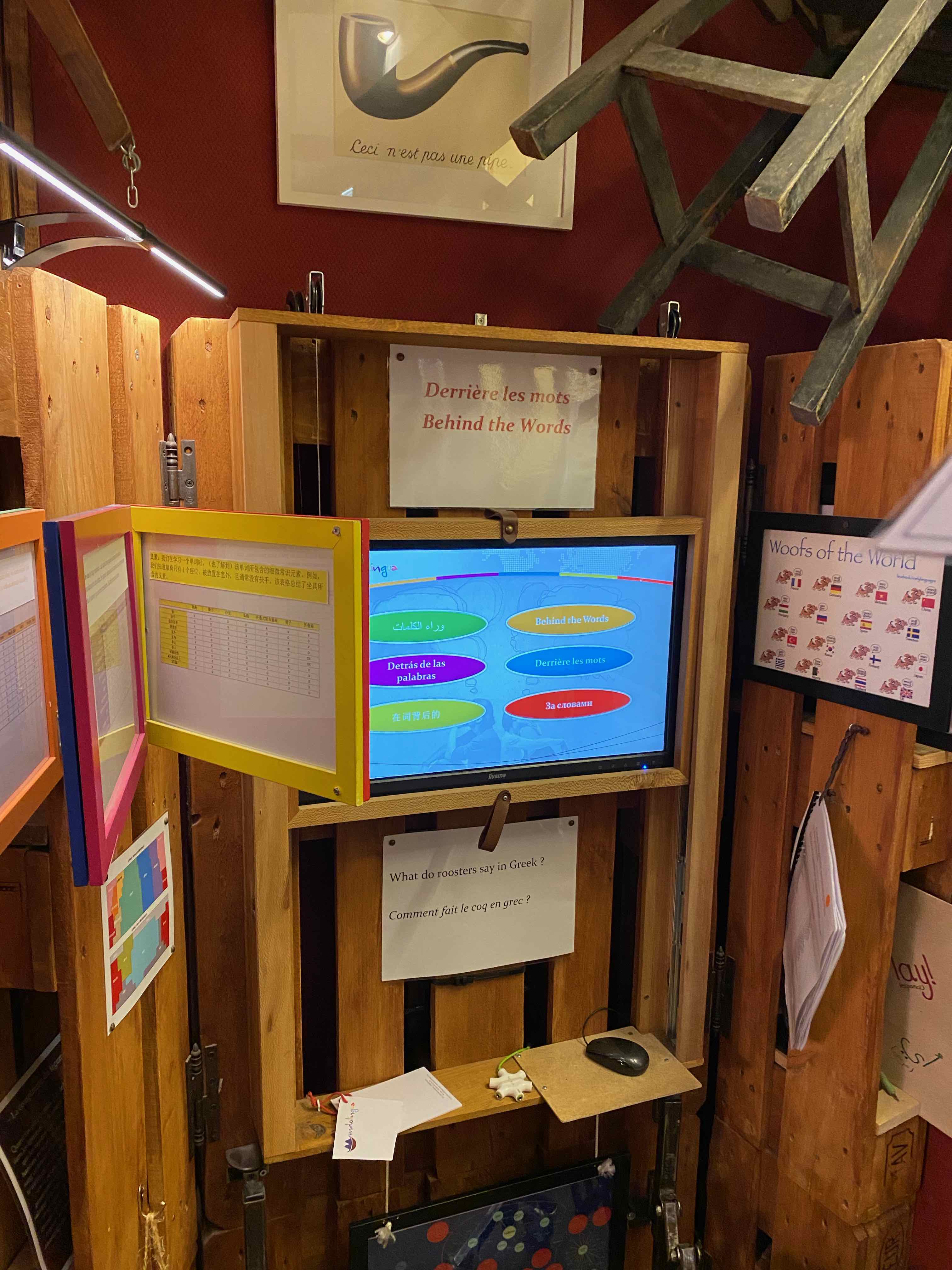
Mundolingua: A Word Museum Paris


Near Luxembourg Gardens in the 6th Arrondissement of Paris is Mundolingua a museum of words: "Stacks of books and dictionaries share space with dozens of digital screens, the intimate exhibit spaces at once cozy and quirky. Words in many languages and alphabets adorn the walls, and, as you wander from the first floor down to the building’s 17th-century cellar, you are surrounded by languages at every turn."
   
Please follow the link above if you are interested. Better yet, if you get to Paris add ths odd museum to your list of sites to vist.


Friday, September 15, 2023

Autoworld Brussels--The American Cars


Autoworld Brussels has many groups of cars in its huge collection. One big group is American  cars.  Mostly mid century. Some real beauties, some strange ones.

1975 AMC Pacer

1965 Lincoln Convertible

1958 Cadillac Fleetwood

Harley Hog

1948 Chrysler New Yorker Convertible


1965 Amphicar 770

1956 DeSoto Diplomat Custom Convertible

1956 Chevrolet Nomad


Monday, August 28, 2023

Escher Museum, The Hague


While I was in The Hague, capital of The Netherlands, I visited the M.C. Escher museum. His works are illusions within illusions. Here are several.


One of the rooms within the museum is an illusion itself with Escher work displayed inside a larger illusion.


Suresnes American Cemetery and Memorial

  Perched on the slopes of Mont Valérien just west of Paris , the Suresnes American Cemetery is the only American military cemetery from t...