Monday, May 12, 2025

The Nazi Apprentice: Eichmann Sent Thousands of Jews to Palestine Before He Sent Millions to Death Camps


Adolf Eichmann on Trial in Jerusalem

In 1932, Adolf Eichmann was an unemployed Austrian who went to Germany to join the Nazi Party. He needed a job. 

He eventually found work in the Nazi effort to make Germany Judenrein, free of Jews. From the time Hitler took power in 1933 until he started World War II, the Nazis deported Jews from the Reich, mass murder was still in the future of the Nazi program. 

Eichmann had a gift for logistics, for organizing.  The Nazi effort to deport Jews in the 1930s was slow because those who wanted to get out had to get authorizations from many agencies.  Eichmann brought all of the organizations necessary into one large building and processed Jews for deportation in days instead of months.  

In that process, Eichmann took the property of the Jews: emptied their bank accounts and left them with just enough to get to their destination.  Thousands of those Eichmann processed got to British Palestine, some got to Spain and to other countries the Nazis never conquered.  Although they lost all of their possessions, the Jews Eichmann deported got away from the Holocaust. 

When the war began, deportation stopped.  For more than two years, Eichmann and his fellow Nazis who were deporting Jews waited for a decision about the fate of the Jews and their next mission. During this period millions of Jews were murdered singly and en masse by shooting, but the killings were mostly done where the Jews lived. No need for transportation.

In January 1942, the Nazis decided to kill all Jews within their territories.  The skills Eichmann had sharpened in organizing the deporting of Jews outside the Reich were used to transport Jews to Auschwitz and other death camps.   

Eichmann refined his methods until in 1944 in Budapest, with the cooperation of Jewish leaders, he deported nearly half a million Jews to their death in just three months.  

Eichmann was not a supervillain. He was a skilled organizer of transport and paperwork with years of experience.  When the Nazi policy was deportation, Eichmann got Jews out of Germany.  When the policy was mass murder, Eichmann filled train cars with victims. He was an amoral functionary who obeyed orders to the point of transporting three million Jews to Death Camps.  

When the war ended with Nazi defeat, Eichmann hid in Austria until the Rat Line organized by Catholic Bishop Alois Hudal got Eichmann to Argentina. The pro-Nazi Pope Pius XII was still in power as Nazis slid to South America. In Argentina, Eichmann bragged about his crimes. He was kidnapped by Israeli agents and put on trial on Jerusalem. 

Eichmann was executed for his crimes in Israel. 

I have read and reread Hannah Arendt's report on the Eichmann trial. She had many critics ofher work during her lifetime and still does fifty years later.  then as now, most ofher critics have not actually read her book.

I can recommend all of Hannah Arendt's books, which I did  in brief summaries here. Her book The Origins of Totalitarianism is the most important of her books in understanding the horror of the Holocaust. 


Monday, May 5, 2025

Potholes in Panama City, Panama


In 10 days I will end my nine-month stay in Panama City, Panama. I loved many things about my stay here and met many great people.  But riding here was always tense and difficult. 

Today I rode about 20 miles and created a new facebook group to share pictures of Potholes in Panama City.  Sometimes my bike is in the picture. Sometimes just the pothole.  

I ride here because I ride everywhere, but between narrow roads and deep potholes and no shoulders, I will be glad to be home in Pennsylvania.  

https://www.facebook.com/groups/3523199161309187 


Some of my other posts about riding in Panama:

Buying a bike.

First flat in a pothole.

First riding post.

Riding in western Panama.


Wednesday, April 30, 2025

Trump Fan Suddenly Worried About Liberty: Rod Dreher Realizes Trump Could Threaten White Christians Too!!

Rod Dreher

 I wrote this essay/review after reading The Benedict Option by Rod Dreher in 2017. This tireless exponent of Christian Nationalism is suddenly worried about liberty in America. Or maybe his bank account. It was the worst book I read that year.

When you want to say the nation is going to Hell, you first need a villain. Then you need to say how that villain is going to ruin everyone’s lives. The central theme of The Benedict Option is Dreher predicting the end of Christian culture in America through gay rights and the gay agenda. Dreher is sure that Christian hegemony in America is over. The only option is to withdraw from life in corrupt America into intentional communities of those committed to real goodness. 

The first question I have is, ‘Why will the gay agenda ruin our nation after it flourished with a long history of slavery, Jim Crow and betrayal of Native Americans?’ Is a nation really blessed by slavery and genocide and cursed by gay marriage?

America perpetrated the worst slavery in the history of the world on Africans. They were kidnapped and brought here in chains to be slaves until death for generation after generation. America had slavery with no hope of buying oneself out or getting free. The center of that slavery was the New Orleans slave market.

Dreher grew up in Louisiana and returned there to withdraw from life in big cities.  He is in a state and a region with a horrible history of slavery, followed by 100 years of apartheid called Jim Crow. What could be worse than men who would buy and sell human beings, fight a war to keep their slaves, and then oppress their victims openly for a century after losing the war?

Every confederate battle flag represents unrepentant racism, slavery and murder.  And yet, Dreher says, it is gay rights that will kill Christian faith in a way that Pride, Murder, Rape and Greed could not. Dreher says at the end of the book historians will wonder how a 3% minority killed a great nation like ours.

If America can perpetuate slavery longer than every civilized nation, break uncountable treaties, slaughter Native-Americans, allow Jim Crow laws in the south for a century, and then put a racist sexual predator in the White House with the support of 81% of "Christian" America, can the Gay agenda really trump everything else we have done? Dreher has his enemy.

Dreher begins the book saying he was led to the idea of withdrawal from culture by thinking of his son’s future from the moment he was born.  The book has many instances of Dreher and other Christian parents making what he calls sacrifices for their children.  Dreher writes as if parenting were the central Christian ministry.  As a father of six, I would say parenting is one of the central delights and urges and vanities of the Human Condition.  Can any parent really say that spending their time and money toward the success of their children is a sacrifice?  Does working toward the success of my own children make me the equal of Mother Teresa caring for the poorest outcasts in a Calcutta gutter?  No, it doesn’t. My bright, successful, funny children are a delight, they are not a ministry.  And they in no way set me apart from the world.

I heard many idiots in focus groups and on the news say one proof that Trump was obviously a good guy because he is a good father whose children love him.  Saddam Hussein loved Uday and Qusay. The worst Roman emperors were the beloved, spoiled children of previous emperors.  Trump is, by his own words, a racist who is willing to grab other people’s children by the pussy. Parenting does not excuse pandering.

Dreher should know well that nothing ties a person to the world like having children.  No actual Benedictine has kids.  The withdrawal from the world with kids that Dreher posits is not a new monastic movement, but a gated community with spiritual decorations on the iron fence. 

Compared to, say, Coptic Christians in Cairo and other believers facing danger and death, the Benedict Option like a military video game, allowing the out-of-shape, pale player to pretend he is a combat soldier while in the comfort of mom’s basement away from the blood and bullets of battle.

I would have called it the book the Benedict Fiction.


Tuesday, April 29, 2025

Trust the Science: An Atom of Insight About What "Trusting Science" Means


The first thing to say about my lovely graphic is that John Dalton 
proposed his theory of atomism in 1803, not 1903.  
The rest of the dates are good. 

I trust science. But when I say that, I know I will be misunderstood by almost everyone. Science is an open, shared enterprise which is the best current understanding of the world around us shared by those trained in the field.

Which means the best science at any time and place could and has been wrong or incomplete and can be changed, refined and improved by the latest research.  But science, unlike religion and other beliefs, is self correcting.  When a scientific theory is wrong, subsequent discoveries will change it or make it obsolete.  Since the corrections are in the hands of people not deities, the discoveries happen slowly or rapidly. But when the change happens, the previous understanding is discarded.

The story of the discovery that atoms are the basic unit of matter shows how convoluted the path to knowledge can be.  

Atoms were first proposed as the fundamental unit of matter in Ancient Greece by Democritus and others.  But Aristotle did not believe in atoms, so reverence for Aristotle held kept alchemy in place as the central understanding of what is now chemistry for two millennia.

Then in 1803 after meticulous experiments John Dalton proposed that each chemical element was a unique particle, an atom. Molecules were compounds of different atoms in fixed ratios.  This understanding was refined and expanded for a century until science could begin to "see" inside atoms.  

When scientists began to see inside atoms, when it became clear that atoms were composed of different particles with different charges, the picture of the inside of the atom evolved rapidly.  A century after Dalton, J.J. Thompson believed the atom had negative particles, electrons, embedded in a positively charged sphere.  

Seven years later Ernst Rutherford created the model of an atom with a positively charged nucleus and electrons orbiting: a tiny solar system.  Neils Bohr refined the model to fix levels or orbitals for the electrons circling the atom.  

In 1926 Erwin Schroedinger applied the new discoveries of quantum mechanics to the atom model which is now seen as a positive nucleus that usually includes neutral particles surrounded by a cloud of electrons. And with many small refinements, that is the current atomic model. 

For those who see science as fixed, this timeline shows that in the past three centuries atoms:

Did not exist (until 1803)

Were indivisible spheres (until 1904)

Were positively charged spheres with electrons inside (until 1911)

Were little solar systems held together by electrical forces (until 1926)

Are a nucleus of many types of particles surrounded by a cloud of electrons (1926 and following)

The leading edge of understanding in any field can always change. If something radical changes in the current understanding of atoms and molecules it will be particle physicists and theoretical chemists who find the new wrinkle in the fabric of the universe. And their colleagues around the world will challenge their insights.

The alternative is the chaos of people sharing ignorance on the internet and turning our understanding of the world into an opinion poll. Or worse, shutting down research by experts. 

The best book I have read on this consensus of science is The Constitution of Knowledge: A Defense of Truth by Jonathan Rauch. I'm sure I will re-read it soon as we descend further into ignorance and chaos.


Friday, April 25, 2025

Visiting BioMuseo in Panama

Last weekend, I finally visited the Bimuseo on the Amador Causeway in Panama City.  It presents the amazing biodiversity of the newest part of North America. What is now Panama was a gap between the American continents then plate tectonics and volcanos made a narrow east-west bridge between what is now Columbia and Central America.  


Biodiversity followed the formation of the new land as animals and plants great and small made their way to and through the strip land between the Atlantic and Pacific Oceans.  At the narrowest point in the middle of Panama (No surprise, the location of  the Panama Canal.) the country is less than 50 miles wide, spreading to more than 100 miles wide east and west of the canal.  


When a population is separated and isolated from each other and has different sources of food, new species can form.  In Panama this process formed, for example, two hundred species of bats within the borders of a country just four hundred miles long. Plants, insects, reptiles, birds and other creatures all evolved into new species inside the little country that connects the great continents.


On either side of Panama to the north and south marine species that once swam between the two oceans were separated and formed their own ecosystems in the oceans.  In this sense, the Panama Canal doesn't connect the two oceans. The canal rises from each ocean to Gatun Lake in the middle of the country 26 meters above sea level.  The lake is fed by the Chagres River which empties into the Atlantic Ocean on the north side of the canal.  

The water that fills the locks and floats the ships across the country flows down from Lake Gatun into the locks and out to sea. If the canal had been built at sea level through Nicaragua (one of the plans in the late 1800s) it might have been a path between the seas for marine creatures. But in Panama, the canal is a fresh-water path flowing out to the seas from the lake in the middle.


The biodiversity the Biomuseo presents is evident around me every day I live in this lush country. Animals, birds and plants unique to Panama are visible everywhere and, of course, many more are invisible.  


Saturday, April 19, 2025

Advocating for Ukraine: Telling Our Representatives That Ukraine is the Front Line of Freedom and Democracy

The Pennsylvania Delegation of the Ukraine Action Summit

At the beginning of April, I flew back to America to be part of the Ukraine Action Summit. The song that turned into an earworm was Hail Night of the Woeful Countenance from the musical Man of La Mancha.  In a Republican-controlled Congress, both the House and the Senate, and with a Putin-loving President, I felt I was tilting at windmills.  

I am an American and can tell my elected representatives how I feel about Ukraine. Which I did.  And have been doing since this terrible war started.  

By the way, in case someone reading this hear Kremlin talking points from Tucker Carlson or Putin-loving minions: 

Russia invaded Ukraine.
Russia kidnaps Ukrainian children.
Russia targets homes and schools and civilians.
Russia betrays every agreement it makes.
Russia does not want peace and American negotiators are idiots.
 
I will keep advocating for Ukraine for as long as Ukraine keeps fighting back against the vile invaders of their land.  

As a veteran who enlisted during four different wars between 1972 and 2016,  the Cold War was the only win America had.  And the Trump Republicans have trampled on that victory and taken Putin's side in this fight.  

Nearly 200 years ago in his book Democracy in America, Alexis de Tocqueville said the leading struggle in the 20th Century would be between Russia and America. He was right, as he was right about so much about America. And yet, that brilliant French writer would never have predicted that an American President would have the spine of a jellyfish and become the willing slave of the Russian President.  But here we are.     


Saturday, April 12, 2025

Has the Invasion Begun? No Ships at the South End of the Panama Canal

The view from the Amador Causeway. 
No ships at the south end of the Panama Canal.

Just after midnight today I returned to Panama after two weeks in the US, preceded by two weeks in Chile.  I rode to the Amador Causeway which is parallel to the south end of the Panama Canal.  

There were no ships going into or  coming out of the canal.

None.

I rode to the end of the Causeway, turned around and saw one completely empty container ship headed out into the Pacific Ocean.  

Then I went to a coffee shop across from the rail yards at the Balboa container port.  Some days I watch huge forklifts zooming along the tracks putting 40-foot containers on rail cars in one smooth move, or unloading a train from the Colon port.  

Today, the train sat unattended. Behind the rail yard I saw the huge container cranes of the port. In almost an hour I saw none of the move.   

After a month away, I wondered what I would see as I rode along the port.  

I saw the effects of the uncertainty of  tariffs.  Nothing moving. 

Is this the master plan for the Canal takeover?  Impose tariffs wildly, stop shipping and bankrupt the canal company? 

Not likely.  

It will be fun to watch how the tariffs affect global shipping, since I have a front-row seat.


Saturday, April 5, 2025

"You Can Tell Who Boozes by the Company He Chooses" Another of my Dad's Axioms


Lt.George Gussman in 1943

One of my Dad's favorite axioms for life is the phrase "You Can Tell Who Boozes by the Company He Chooses." He never used it specifically about someone who was drinking too much, at least in my hearing. He first used it to tell me he did not think my friends were good kids when I was in middle school. He was right. I would never have admitted it at the time.

Once we were standing on the loading dock at the warehouse where he worked full time and I worked summers and Saturdays. One of the truck drivers was talking to a guy who drove up in a gold Lincoln Continental with suicide doors.  


Dad said, "You can tell who boozes by the company he chooses." Then he turned and walked back into the warehouse saying nothing else. He liked Tony, the driver who was talking to the bookie, but Tony had a gambling problem.  Anyone who walked out to the Lincoln was headed for some sort of trouble.

I thought of Dad's phrase when Trump took office the first time.  A translation of the phrase is a person's character is evident in the people who are their closest friends and associates.  But the new administration is nothing but broken men and women whose only requirement for office is loyalty to Trump and the willingness to say the 2020 election was stolen. 

Trump's first nominee was Matt Gaetz, who bragged about having sex with underage girls. He was too toxic even for Trump worshippers.  But public drunk Pete Hegseth is Secretary of Defense. RFK Jr. is in charge of our nation's health. Putin lover and friend of the Syrian dictator Assad Tulsi Gabbard is in charge of intelligence.  Wrestling exec Linda McMahon is in charge of dismantling the Education Department.

These losers and many others show Trump's character. "You Can Tell Who Boozes by the Company He Chooses" should be on the wall in every Trump cabinet meeting.   


Sunday, March 30, 2025

Living at the Beach in Vina del Mar, Chile


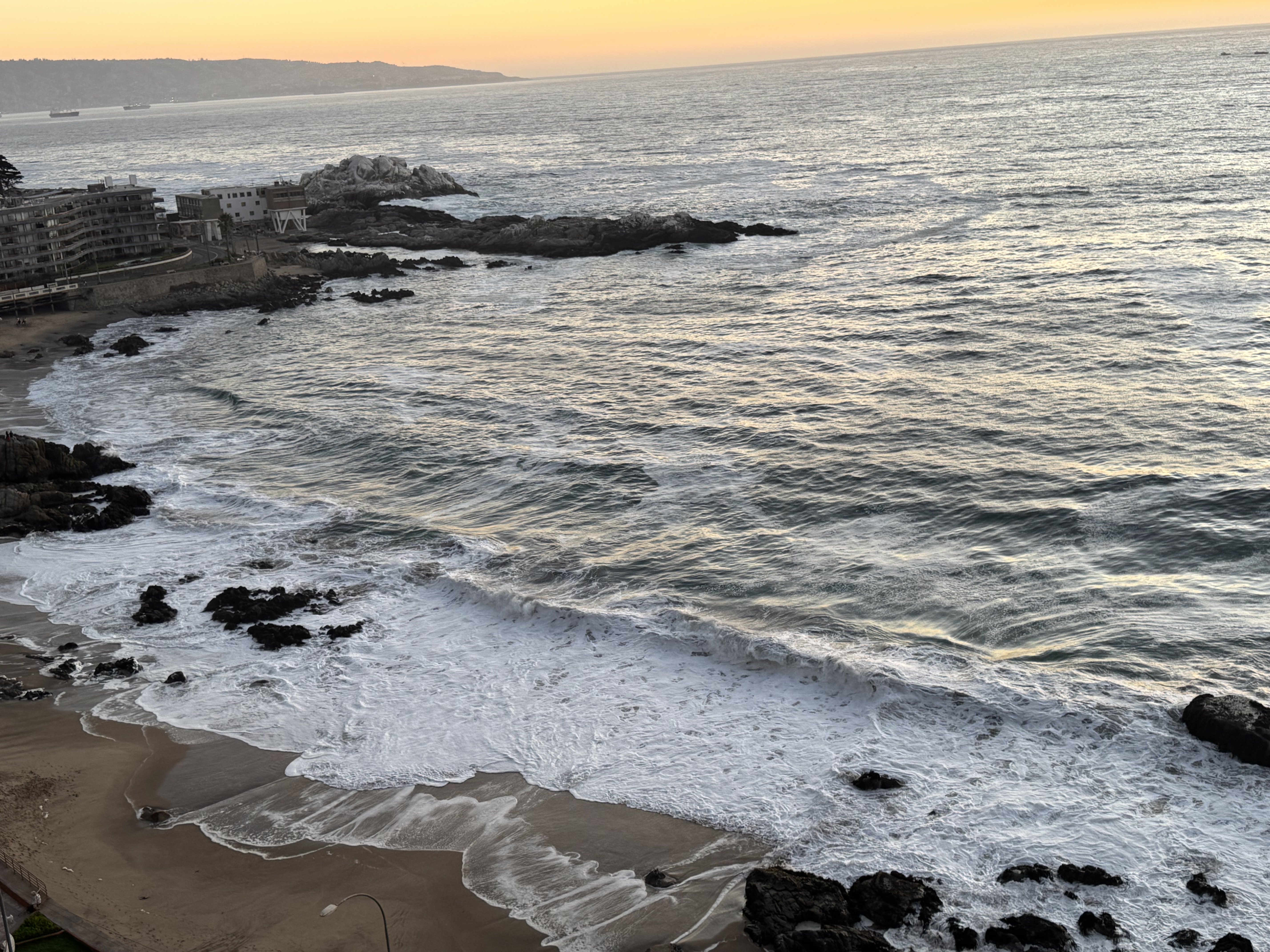
For two weeks I lived across the road from the beach at Vina del Mar, Chile. The weather was lovely--high 60s (20C) during the day and low 50s (12C) at night. The sound of the surf all day and night.  

If I get a chance to return to Chile I would like to spend time at Vina del Mar, but definitely want to go south.  I want to explore Tierra del Fuego and Patagonia.  I want to ride up to the ski resorts in the Andes. What a beautiful country.  

And the sunsets.......


Monday, March 24, 2025

George Washington to Donald Trump--Falling into a National Abyss


George Washington was a brave and passionate young man who by will and desire controlled his internal fires. He made himself the stern man who could lead a new nation during and after the Revolution that brought the nation into being.  I am reading a Pulitzer-Prize-winning biography of George Washington by Ron Chernow.  The more I read, the more I admire the man who was the symbol of America before there was a capital, a flag or a national government.  

And with each page, the contrast between the man who brought America into being and the dissolute dumpy draft dodger in the White House is more vivid. Washington was a colonel in the Virginia militia during his early twenties. He was celebrated for heroism in England and the colonies for his bravery during the Seven Year’s War: at the same age our current President had draft deferments for invisible bone spurs.  

When Washington first took command of the continental army in Cambridge, there was an outbreak of smallpox in Boston where the British held the city.  The British using 18th Century biological warfare, sent boatloads of infected Boston residents across the Charles River to Cambridge to spread the disease.  Washington, who had taken the crude vaccine himself, ordered his soldiers to be vaccinated.  He carefully quarantined the infected Bostonians sent across the Charles River.  

Today, the anti-vaxxer in chief appointed a lying vaccine skeptic to be the head of Health and Human Services.  In a less-known act, Trump re-instated soldiers who refused the Covid vaccine while on duty. Returning to the ranks soldiers who refused orders will make the US military exactly the kind of “losers” he said happened under the previous President.  Washington knew discipline (obeying orders) made the army effective. Whining idiots who refuse a vaccine could refuse to fight. How much worse is combat than a Covid shot?  

Martha Washington traveled from Virginia to wherever her husband was during terrible winters such as the one in 1976-77 to be with her husband. Martha was terrified of the vaccine which nearly claimed the life of her son, but George insisted she be vaccinated to be with the army.  She took the vaccine, was ill for a month and recovered.  I think soldiers should be at least as brave as George Washington’s wife. 

Washington had an eye for good leaders. The best men in his army rose rapidly through the ranks. Generals Green and Knox notably rose rapidly to important commands as did young officers who caught Washington’s attention.  As against the British army with its deep class distinctions, Washington’s army was a meritocracy, bringing the best to the top.  Trump has appointed a Star Wars bar scene of misfits to corrupt and destroy the government.  Notable in the inventory of idiots is talk-show-host Pete Hegseth, the secretary of defense.  Will this moron even be sober if Russia attacks Europe? 

Can America survive this onslaught of mediocrity?  I don’t know. When we survived the Civil War, Americans still admired courage and thought the President should be a leader of great character.  Last year America no longer cared about character.  A mean mediocrity was their pick to make America great again.  Not even 100 days into utopia, the economy is tanking because the 20th century man in the White House is re-instating the tariff wars of the 1920s. How did that turn out?  

Stupid is not only infinite, but bipartisan. Even as I despair of the descent from the dignity of Washington to immoral mutant Trump, I know that people who agree with me about Trump will howl about Washington, Jefferson and other of the founders of America who owned slaves.  Whatever their flaws, the nation they founded eventually fought its bloodiest war to end slavery.   

The critics of Washington and America right now are protesting in favor of Jihad on and around college campuses and major cities.  The most pathetic of them are Gays for Gaza.  Only Israel in the entire Middle East would allow gay people to live in safety, to live at all.  In Gaza or any Jihad land, gay people, whatever their pronouns, would be stoned by a gleeful, hateful mob doing the will of their hateful god.  Pro-Hamas is not less vile than Pro-Trump.  And both are willing to sacrifice their followers without a second thought.   

Washington led by stern example in the face of enemy fire, then retired to Mount Vernon when he could have been a king.  From the dignity of Washington we have descended to the lying delusions of Trump. And worse than that, a majority of America vote for him. 

This pathetic fool will be President for the 250th anniversary of the USA.


Wednesday, March 19, 2025

Chilean Sunset--Riding in Another Country South of the Equator


For the next ten days I will be in Chile before returning to Panama.  I got a bike yesterday, so I will have a week of riding the hills above the beach in Valparaiso and along the beachfront.  This is  my first trip to Chile, the fourth country I have visited in South America. I have also been to Argentina, Brazil and Columbia on this continent.  

As with other countries south of the equator, riding in Chile is strange because the sun crosses the sky in the north, rather than the south.  Since the late 1980s, I have ridden more than 150,000 miles in the northern hemisphere and a few thousand miles either near the equator or in the southern hemisphere.  

Riding in the northern hemisphere, especially in cold weather, conditions me to feel the sun in the south. As I ride due west, for example, my left side is slightly warmer and the glare of the low winter sun is in my left eye. Tens of thousands of miles and decades of riding burned this into my mind as "normal."  

My first ride in the southern hemisphere almost 30 years ago was due west from Perth, Australia, to the Indian Ocean. It was mid July, winter, and barely above freezing. On that 20-km ride, I stopped twice. My body told me I had to be going the wrong way because my right side was warmed by the sun. Instinct led me to think I was somehow going the wrong way. I was not.

For the next week in Chile, I will have the same instinctual feeling of going the wrong way.  When I ride south and have the sun behind me, I will have to tell myself nothing is wrong. 


In the meantime, the view along the coast is spectacular. 

As an aside on travel, I have been to all six continents, and ridden in five. I have yet to ride in Africa. Chile is the 62nd country I have visited. I have lived in five countries including the US.  

Also, South American and Oceana are the two continents where I have ridden in all the countries I have visited. Four countries in South America. And in Oceana, I have only visited one country, Australia, and ridden in it.

I have only been in five countries in North America and ridden in just three:the US, Canada and Panama. I have not ridden in Mexico or Haiti.

Which means I have ridden in 43 of the 55 countries I have visited in Europe and Asia. 

I have ridden a bike in more countries that I have done any other activity I keep track of.  For example, I have been in an airplane in 43 countries, driven in 30, ridden in a train in 25, used a laundromat in 21 and swam in 14. My biggest decade for travel is the current one. I have visited 35 countries since January 2020.  

I'm not sure when I will ride in another country. I have no  definite plans to visit a new country in the near future. I have ridden in 35 of the 41 United States, so I have more states to visit sometime in future.  


Friday, March 14, 2025

The Divider


Those who love Trump believe he has many talents.  But one stands out. He is better than anyone at dividing people.  His instinct for what will tear apart any group is nearly flawless. 

This week, Jews across America get more divided each day over the arrest of Mahmoud Kahlil. Why did ICE arrest Kahlil?  They could have deported a dozen, a hundred, or more students on visas and had very little blowback.  On a student visa, supporting terrorists is automatic deportation.  

But Kahlil has a green card so his free-speech rights are ambiguous. He is not a student but is living in student housing. His wife is eight months pregnant so he is more sympathetic than that other supporters of Hamas terror.  

Why him?

Because he will give Trump a controversy to point to every time something does not go his way. Kahlil will likely get deported. The conservative high court is not going to give him the benefit of the doubt if it gets that far.  

For Trump, the support for Kahlil is just another deep-state defense of terrorism.

For some Jews Kahlil is a terrorist who should be deported, for others, he has rights and Jews should protect the rights of everyone because we will be next.

Whatever the fate of Kahlil, the divisions among American Jews will be deeper.


Thursday, March 13, 2025

Every Living Thing: The Great and Deadly Race to Know All Life by Jason Roberts


For most of the last 20 years, I have attended the weekly discussions of the Evolution Roundtable at Franklin and Marshall College a few blocks from my home in Lancaster, Pennsylvania. The ERT reads two books each year on evolution, one each semester.  We have read books The Origin of Species, The Selfish Gene, and many other books on dinosaurs, DNA and how cells evolve. In the 1990s, before I was part of the group, Stephen Jay Gould visited one of the Monday noon sessions.

If I could recommend just one book of all those I read with the ERT, in fact any single book I read on science, it would be Every Living Thing: The Great and Deadly Race to Know All Life by Jason Roberts.  I liked this book from the introduction, but the more I read it, the more I was drawn into the parallel lives of Carl Linnaeus and the Georges-Louis Leclerc Comte de Buffon.  

These men both lived and worked through much of the 18th Century. Both devoted their lives to classifying every living thing, plus rocks and minerals and even the universe beyond the earth in the case of Buffon.  Both men wrote a single work in many volumes with many revisions for their entire lives, describing every sort of life they could find. 

During their lifetimes, both were well known. Both suffered tragic and painful deaths. But that's where Roberts tale really took hold of me. He tells the story of how the ideas and reputations of the two men rose and fell after their deaths.  This story shows how much science is influenced by culture and politics and the whims of people with an agenda having nothing to do with the work of the scientist. 

 Linnaeus died in 1778 in Sweden, a country that would remain relatively stable in the centuries ahead. Buffon, a rich French aristocrat, died in 1788 on the eve of the French Revolution.  Among the excesses of the French Revolution was erasing anything aristocratic, along with murdering aristocrats.  One of the revolutionary committees decided Linnaeus was a man of the people and Buffon should be erased.  

The revolutionaries promoted Linnaeus. Buffon and his multi-volume work went into eclipse. Right now on Amazon there are 50 books on Linnaeus plus children's books. Since Linnaeus was a creationist who believed all the species were created by God in the week described in Genesis Linnaeus has a Christian home-school following. 

In the mid 19th Century, when Charles Darwin published The Origin of Species it was clear that the work of Buffon had anticipated evolution.  When genes were found to be the inner mechanism of life and reproduction, Buffon's work again seemed prophetic.  In the 21st Century with millions of species and many more more types of life that are neither plant nor animal, the Linnaean system is being supplanted. Linnaeus thought God created 40,000 species. His system is overloaded with a thousand times more. 

Why this book above every other book on evolution? Because Every Living Thing shows the reader the obsession, the rivalry, the passion, the determination of scientific discovery and then shows how history and politics can promote or ignore a lifetime of work. Real science is always changing, always affected by the culture in which it works.  

Right now uncertainty will hinder science in America, maybe leading it to flourish elsewhere.  Germany was the center of the scientific world in the late 19th and early 20th centuries. Then the Nazis took over and German science never recovered. 

Chance and circumstance affect us all and science no less. 


Thursday, March 6, 2025

Freedom by Sebastian Junger


Freedom by Sebastian Junger is first and foremost a Quest or Journey Away, an adventure leaving home.  Junger and his friends walk the railroad tracks that connect Harrisburg and Pittsburgh, Pennsylvania.  The fast-moving narrative takes the reader northwest up the Juniata River valley beginning where it joins the Susquehanna River, then at the headwaters of the Juniata turns southwest along the freight and passenger line that passes through Altoona's Horseshoe Curve on the way to Steel City. 

As the group strides alongside the tracks, we learn about the mechanics of long-distance walking, including why the spacing of the ties makes it so difficult to walk on the wooden crossties that support the steel rails.  

Before the path along the river was railroad right of way, it was a trail used by settlers moving west and the tribes who lived on the land before them.  Junger tells us some of history of the tribes and how they fought and allied with settlers. We also learn the history of tribes and individuals far from Pennsylvania. There is a long section on the Apache on the US-Mexican border.

One of these narrative asides describes how George Washington is reputed to  have started the French and Indian War. In 1754 Washington led an attack on a French detachment at what became known as Fort Necessity. Washington won the skirmish. The French surrendered, but the Mingo tribesmen led by the warrior known as the Half King slaughtered and scalped some of the French.  What became the Seven Years War arguably began with that battle and its bloody aftermath.  

The narrative is interspersed with meditations on what it means to be free in modern America and back through the history. 

On the history of freedom versus the modern democratic world:

“For most of human history, freedom had to be at least suffered for, if not died for, and that raised its value to something almost sacred. In modern democracies, however, an ethos of public sacrifice is rarely needed because freedom and survival are more or less guaranteed. That is a great blessing but allows people to believe that any sacrifice at all--rationing water during a drought, for example--are forms of government tyranny. They are no more forms of tyranny than rationing water on a lifeboat. The idea that we can enjoy the benefits of society while owing nothing in return is literally infantile. Only children owe nothing.”

On leaders who exploit their freedom:

“But in any society, leaders who aren’t willing to make sacrifices aren’t leaders, they’re opportunists, and opportunists rarely have the common good in mind. They’re easy to spot, though: opportunists lie reflexively, blame others for failures, and are unapologetic cowards.”

Wealth erodes freedom:

“Wealth is supposed to liberate us from the dangers of dependency, but quickly becomes a dependency in its own right. The wealthier we are, the higher our standard of living and the more—not less—we depend on society for our safety and comfort.”

On the freedom of the journey at the center of Freedom:

“We walked around four hundred miles and most nights we were the only people in the world who knew where we were. There are many definitions of freedom but surely that is one of them.”

On freedom and power:

“The central problem for human freedom is that groups that are well organized enough to defend themselves against others are well organized enough to oppress their own. Power is so readily abused that one could almost say that its concentration is antithetical to freedom.”


Nazi Death Camps and C.S. Lewis

Emily, Me and Cliff Since 2017, I have visited sixteen different Nazi death camps in Germany, Poland, Czechia and France.  A few of them twi...