Veteran of four wars, four enlistments, four branches: Air Force, Army, Army Reserve, Army National Guard. I am both an AF (Air Force) veteran and as Veteran AF (As Fuck)
Sunday, June 5, 2016
Dad's Biggest Payday Ever Thanks to Muhammed Ail
My Dad was a soldier during World War 2 and a middleweight boxer before the war. After the War he went to work for a chain of grocery stores that eventually opened a three-acre warehouse in Charlestown, Mass. Dad was a driver and a warehouseman for Purity Supreme Grocers making about $150 per week in 1964, not bad money at the time.
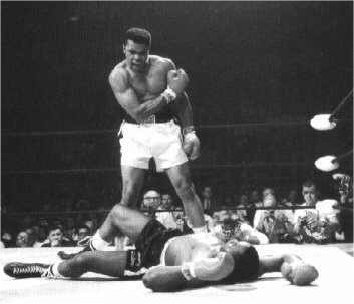
Dad played poker a couple of nights a week and confined his gambling to cards, except for an occasional bet on boxing. In January and February of 1964, the talk among the Teamsters where my Dad worked was all about the Cassius Clay vs. Sonny Liston fight. Most everyone he worked with was sure that Liston was going to pummel the loudmouth Clay. My Dad was equally sure Clay was going to knock out the older fighter.
In the weeks before the fight, bookies were giving ten-to-one odds in favor of Liston. Dad had a savings account he called his "Swiss Bank Account" where he kept his poker winnings. He told me after the fight that he had withdrawn several hundred dollars to bet on Ali.
We listened to the fight on the radio, I don't remember why we could not watch on TV. But Dad was right. Ali KOed Liston and Dad won enough money to buy the only brand new car he ever owned. One of his poker buddies owned a Chrysler dealership in Reading, Mass. He had a new car on the lot for more than a year that nobody wanted. It was a blue 1962 Chrysler Newport sedan, the absolute basic model. It had hub caps instead of wheel covers and it had a three-speed manual transmission with a stick shift. My Dad bought the car with his winnings from the fight. Dad never said how much he won, but it was clearly more than $2,000--the biggest payday he ever had.
Shortly after that fight, Clay changed his name to Muhammed Ali. My Dad remained a fan. "He's a loudmouth, but he is not all talk. He can fight," was my Dad's view of the Ali.
Saturday, June 4, 2016
History Made Wonderful! Podcast Review: The History of Rome
At a recent meeting, the group leader gave us some
“get-to-know-you” questions. One was
“What’s your favorite group/singer and your favorite song.”
But I haven’t listened to that song in months. Questions
like this remind me that most people listen to music when they drive, work,
exercise or commute.
Really, I should have said my favorite “singer” is Mike
Duncan; my favorite song is his “The History of Rome” podcast. The podcast was launched on iTunes in
September 2007 and was an instant and enduring hit. I did not begin listening until 2013, long
after the final episode was on iTunes, but the podcast was still in the Top 50
on iTunes at that time.
In nearly 200 episodes (179 numbered episodes, some with
multiple parts) Mike Duncan guides us from the founding of Rome through the
Republic, Julius Caesar and the Civil War, then through the many great and
terrible Caesars who followed to the end of the Western Empire in the late
400s. Duncan did not try to chronicle
the Eastern Empire through its end in 1453.
I have read and re-read the Aeneid, including reading it in
Iraq. I love history well told and “The
History of Rome” is 70 hours of solid information by a great storyteller.
If you have not listened to podcasts and are interested in
history, “The History of Rome” is a great place to start. And the series has its own Wikipedia page.
Sunday, May 29, 2016
Who Hates Amish and Mennonites? World War II Veterans and their Families
When I moved to Lancaster County in 1980 to go to college, I was surprised to find people who hated the Amish and Mennonites. Who could hate people who drive buggies and farm with mules?
World War II veterans.
From 1981 to 1985 I worked on the dock at the Yellow Freight break-bulk terminal in East Petersburg, just north of the city of Lancaster. As I got to know my co-workers, they mostly fit in three groups:
- Former athletes, either amateur or college, with a career-ending injury, but who could still load trucks.
- Vietnam War veterans and other former service members.
- Farmers who needed the extra money a Teamsters job provided. We made $12/hour.
It was the third group who first told me about how their father or their uncle or their neighbor served in World War II and how the family ended up selling the farm while the soldier was away at the war. The buyer of the farm was often an Amish or Mennonite farmer who did not have to serve in the military and made a lot of money growing food for the war effort.
Nearly forty years later, those resentments were as acute as at the end of the war. "My father did his duty. They stayed home and made money." Most of the men I spoke with had some variation of this statement, usually laced with swearing.
Envy destroys communities. When one guy gets something and the other guy doesn't, hatred follows. Whether pacifists are sincere or not, they start life well ahead of the soldier who goes to war. In yesterday's post I quote C.S. Lewis on why he is not a pacifist. You can follow the link or read it here:
Lewis describes the life of a soldier on active duty in a war:
All that we fear from all the kinds of adversity, severally,
is collected together in the life of a soldier on active service.
Like sickness, it threatens pain and death.
Like poverty, it threatens ill lodging, cold, heat, thirst, and hunger.
Like slavery, it threatens toil, humiliation, injustice, and arbitrary rule.
Like exile, it separates you from all you love.
Like the gallies [jail], it imprisons you at close quarters with uncongenial companions.
It threatens every temporal evil—every evil except dishonour
and final perdition, and those who bear it like it no better than you would like it.
Then he describes the life of those who avoid service,
whether by pacifism or other means:
Though it may not be your fault, it is certainly a fact that Pacifism
threatens you with almost nothing.
Some public opprobrium, yes, from people whose opinion you discount
and whose society you do not frequent,
soon recompensed by the warm mutual approval which exists,
inevitably, in any minority group.
For the rest it offers you a continuance of the life you know and love,
among the people and in the surroundings you know and love.
All that we fear from all the kinds of adversity, severally,
is collected together in the life of a soldier on active service.
Like sickness, it threatens pain and death.
Like poverty, it threatens ill lodging, cold, heat, thirst, and hunger.
Like slavery, it threatens toil, humiliation, injustice, and arbitrary rule.
Like exile, it separates you from all you love.
Like the gallies [jail], it imprisons you at close quarters with uncongenial companions.
It threatens every temporal evil—every evil except dishonour
and final perdition, and those who bear it like it no better than you would like it.
Then he describes the life of those who avoid service,
whether by pacifism or other means:
Though it may not be your fault, it is certainly a fact that Pacifism
threatens you with almost nothing.
Some public opprobrium, yes, from people whose opinion you discount
and whose society you do not frequent,
soon recompensed by the warm mutual approval which exists,
inevitably, in any minority group.
For the rest it offers you a continuance of the life you know and love,
among the people and in the surroundings you know and love.
Saturday, May 28, 2016
For Most Countries, At Most Times, People Looked at Military Service with Dread
C.S. Lewis, best known for The Chronicles of Narnia served in World War I in the British Army. He was a citizen of Northern Ireland and was not subject to the draft, but volunteered to serve. He was badly wounded twice and between battles lived in cold, muddy trenches. During the first year of World War II, Lewis spoke to a pacifist society at Oxford with the title "Why I Am Not a Pacifist." Most of the speech is technical, but he gave a haunting summary.
He describes the life of a soldier on active duty in a war:
All that we fear from all the kinds of adversity, severally, is collected together in the life of a soldier on active service.
Like sickness, it threatens pain and death.
Like poverty, it threatens ill lodging, cold, heat, thirst, and hunger.
Like slavery, it threatens toil, humiliation, injustice, and arbitrary rule.
Like exile, it separates you from all you love.
Like the gallies, it imprisons you at close quarters with uncongenial companions.
It threatens every temporal evil—every evil except dishonour and final perdition, and those who bear it like it no better than you would like it.
Then he describes the life of those who avoid service, whether by pacifism or other means:
Though it may not be your fault, it is certainly a fact that Pacifism threatens you with almost nothing.
Some public opprobrium, yes, from people whose opinion you discount and whose society you do not frequent, soon recompensed by the warm mutual approval which exists, inevitably, in any minority group.
For the rest it offers you a continuance of the life you know and love, among the people and in the surroundings you know and love.
Subscribe to:
Posts (Atom)
Partly Strong, Partly Broken by Nathaniel Popkin
Nathaniel Popkin’s Partly Strong, Partly Broken is a novel about a Jewish congregation, but it is really about the much larger question o...
-
When I re-enlisted in the Army in 2007, I saw several soldiers with Μολων Λαβε tattoos and Μολων Λαβε stickers on their pickup trucks. I...
-
Tasks, Conditions and Standards is how we learn to do everything in the Army. If you are assigned to be the machine gunner in a rifle squad...
-
The map of the divided America in"Civil War" The new movie Civil War is a love letter to journalism, maybe a little too mu...