Wednesday, March 2, 2022

Flying with No ID


Today my son Nigel was flying to the east coast and had an ID that said "Not for use as Federal Identification." I had not gotten him a RealID.  I had not gotten one for myself either. I was going to get one in 2020, then COVID put it out of my mind. 

I was worried he would not be able to board the plane.  It turns out it is possible to board a plane without ID. People lose their wallets, passports and other necessary ID and still fly.  

My daughter Lisa said it would be Okay.  And it was. Nigel's ID scanned and he boarded the plane.  Lisa assured me that if he had no ID he would have been questioned, but would still have boarded.  She said, "I have the kind of friends who lose their ID. Trust me."

Then I realized that in the fifty years from my first flight to basic training January 31, 1972, to now I have always had whatever was the proper ID.  Passport, drivers license, military ID.  

It's nice to know if I forget, lose, or otherwise end up without and ID, I can still get home.  Nigel and I will be visiting the DMV next week to get RealIDs, just in case. 

Monday, February 28, 2022

War and Wooden Shoes

Sabot is one of the names for the wooden shoe that in the Lexicon of War.

One of the reports I heard about the Invasion of Ukraine talked about Russian saboteurs sneaking into the capital Kyiv.

The word saboteur is French using a Dutch word for wooden shoes.  The sabot was a wooden shoe worn by Dutch workers, either the single piece of wood as in the photo above or a wooden sole with various materials forming the upper part of the shoe.  

Sometimes angry workers would throw these wooden shoes into machines and stop work at factories.  One who breaks a machine by throwing a wooden shoe into the mechanism is a saboteur.  

Long before I learned the source of saboteur, I learned about the Sabot armor-piercing cannon shell fired by all tanks in all armies to defeat enemy tanks.  I was at Fort Knox in 1975 and was surprised to learn that the main round we would fire at enemy (Soviet) tanks was not explosive.  The Sabot round travleed a mile-per-second to target and destroyed enemy tanks with impact, not explosion. 

The way sabot came to be used as a name for armor-piercing cannon shells is that the wooden shoes were very easy to slip off. This characteristic led to calling a small armor-piercing round fired a big gun a Sabot round. Since the military always uses a long name reduced to an acronym, the technical description was Armor Piercing Discarding Sabot (APDS) round. 

BEFORE: 25mm (1-inch) projectile wrapped in 120mm cylinder

 
AFTER: 120mm cylinder breaks away at the gun muzzle, 25mm projectile flies to target at 1 mile per second.

The simple, deadly design of Sabot rounds fires a 25mm projectile from a 120mm gun.  With the full force of a five-inch cannon pushing a 1-inch projectile, the tungsten carbide round travels more than a mile a second to target.  There is no explosive charge, the impact of a 5,700-foot-per-second round can punch through more than a foot of armor plate and destroy a tank.  

The humble Dutch workers shoe has become a metaphor for very destructive weapons of war.  Language can be so strange. 

Tuesday, February 22, 2022

Waterloo: A Visit to the Museum and Battlefield


On a cold, clear, windy afternoon earlier this month I visited the museum and battlefield of Waterloo, Belgium: the scene of the final defeat of the Napoleon and his army in 1815.

When I visit the scenes of great battles, I try to imagine myself as the 20-year-old I was when I first made sergeant, leading a squad of men in the face of thousands of enemy soldiers. Chances of me reaching my 21st birthday look very dim in those moments.

The fields of Waterloo are open, flat and a horrible place to be a soldier.  At Gettysburg, I knew I wanted to be in the United States Army. To be in the rebel army, especially in Pickett's Charge, was to have run uphill into artillery behind stone walls.  

At Waterloo, everyone was on rolling open ground, the difference was timing and maneuver. The French were out-flanked, out-maneuvered and finally defeated.  Napoleon Bonaparte was neither the first nor the last general defeated in part by his own arrogance. 

The museum is beautiful and is all underground:


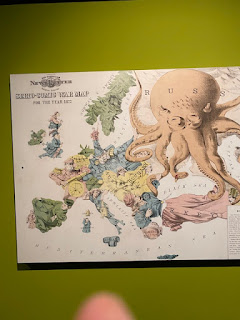
There is a delightful collection of contemporary propaganda:


A huge diorama places all of the armies on the field.  A fixed model can only capture a moment, not the complex maneuvering that led to Napoleon's defeat, but it is nice to be able to look at the model then go out and scan the field.


And in the gift shop, there is a Napoleonic War chess set and the t-shirt I came home with:


My Books of 2025: A Baker's Dozen of Fiction. Half by Nobel Laureates

  The Nobel Prize   In 2025, I read 50 books. Of those, thirteen were Fiction.  Of that that baker's dozen, six were by Nobel laureates ...