Monday, February 14, 2022

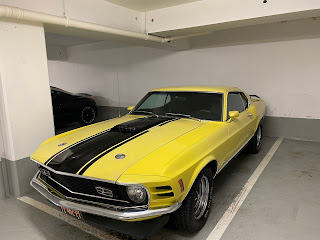
Cars in a Corner of Underground Garage Near Versailles


1970 Ford Mustang Mach I 351 with original paint in a Paris Garage

A few days ago I drove from Paris to Le Mans to visit the museum and track of the annual 24-hour race.  On the way back I stopped at Chartres Cathedral then got a hotel near Versailles.  In the far corner of the second lower level of the underground garage was a 1970 Ford Mustang Mach I with original paint and a Florida license plate.  

It was a delightful surprise to see a vintage American Muscle Car in a French parking garage.  Of the forty cars, trucks and motorcycles I owned during my 52 years of driving, Ford Muscle Cars were some of the best.  I owned a 1969 Torino Cobra, 428CID, Hurst shifter, Holley carburetor and functional ram air. Then I owned a 1972 Mustang Cobra Jet, 351 with a Carter Thermoquad.  Seeing that Mustang after visiting Le Mans was a real moment of nostalgia. 

Also along the back wall of the garage was an Aston Martin DB9 under a cover (marked with Aston Martin and DB9).  


Between the Mach I and the DB9 was a Peugeot RCZ, a lightweight (1404kg) powerful (250hp) little two-seat French missile.


In the far corner of the garage was a mid-1990s Jaguar XJ convertible.  


One of the oddities of the 1970 Mach I was louvres on the back window. By 1972 Ford dispensed with the sun-blocking slats, I wished they had not. My Mustang CJ had a back window so near horizontal that it was useless whenever the sun shined on it.  

Posts about traveling in France and neighboring countries in February 2022:

My favorite restaurant is a victim of COVID.

The Museum of the Great War.

The Waterloo Battlefield.

The Red Baron Memorial.

Chartres Cathedral.

High Performance Cars in a garage in Versailles.

Talking about Fathers and Careers at lunch.


Sunday, February 13, 2022

50th Anniversary of My First Enlistment is This Month


Twas the night before Basic, and I drank way too much. 
I have no photos from my Air Force enlistment.

Fifty years ago today I arrived at Lackland Air Force Base, San Antonio. I was hung over with shoulder-length hair and at the beginning of an on-again off-again relationship with the United States military that would finally end 44 years later in May 2016.  The story of that first haircut is here

Since my first of my four different service branches was the Air Force, basic training was mostly marching and learning military culture.  We had one afternoon on the rifle range, one hike, and one meal outdoors--at picnic tables.  In the nearly three years of my Air Force enlistment I never saw C-Rations let alone tasted them.  Decades later I did a comparison of C-Rations and the current MRE meals that got 100,000+ views on YouTube. Here is the video.

When I left my home in Stoneham, Massachusetts, the Beatles were still together, Elvis was still alive, the Vietnam War was still raging, the Cold War was heating up, the draft was in its last full year, the Muscle Car boom of the 1960s was nearly over, and Donny Osmond had two songs in the top ten singles of 1971.  

Speaking of music, while my shoulder-length hair was shorn from my head in the Air Force barber shop, Merle Haggard's "Okie From Muskogee" played in the background. The only country songs I heard up to that point in my life were some Johnny Cash breakthrough hits that ended up on Top 40 radio, like "A Boy Named Sue." In one of the ironies of military life, Fort Sill, Oklahoma, was the place I trained to deploy to Iraq 37 years later in 2009. In one of the many coincidences of dates in my life, my basic training and pre-deployment training both began on February 1. 

In 1972, phones had wires and were often attached to walls. Every Sunday at basic training we lined up at phone booths to call home.  Cameras had film. Barracks had liars.  Extravagant liars.  My basic training flight was forty men either 18 or 19 years old, from more than twenty states across the nation, living in one big room.  Before lights out, we would shine our shoes in groups and talk.  Some conversations were about training or life in the barracks, or the food we ate, but when the subject was home, the lies swelled to the size of a Goodyear Blimp.  I wrote about those lies and how Facebook killed the barracks liar.  

When we marched we sang songs about killing the enemy, Viet Cong mostly, occasionally a Russian, we sang about our nearly infinite appetites for sex and alcohol, and we sang about Jody--the guy who was back home sleeping with our wife/girlfriend, driving our car, emptying our meager bank account, and in its best country version, alienating the affections of a favorite hunting dog.  

At my last military training school in 2013, we were not allowed to sing any of those songs.  All five military services were in our marching formations, and none of them were allowed to sing any marching song that could be considered sexist. And even though we were in two active wars, we could not sing about an enemy. Jody was off limits.  I wrote about the change in the songs for the New York Times At War blog.

The world in which I enlisted is gone.  I am writing this in a cafe in Paris on a computer with more processing power than the computers that put a man on the moon in 1969.  The flight from home to basic training fifty years ago was the first time I had been west of Cleveland or south of Pennsylvania.  It was my first flight on an airplane.  Earlier this month, my flight to Paris was the beginning of what may be my seventieth trip to another continent either on business, pleasure or a military mission.   

I have a love/hate relationship with the military. Three times, I got out, and said I was done: in 1974, 1979 and 1985.  Three times, I re-enlisted: in 1975, 1982 and 2007.  I finally left the Army National Guard in 2016.  Now I am far too old to change my mind again.  And I am happy with that.  I spent some of the best years of my life in the military, but even if I were not too old, I am happy to let the men and women born in this century defend the country.


Thursday, February 10, 2022

Fathers, the Army and Career Paths in America and France: A Delightful Conversation at Lunch

Professor Christian Amatore of the Ecole Normal Superieure

At an award lunch at a history of science event in Paris, I was seated with Christian Amatore, a professor emeritus of electrochemistry at the Ecole Normal Superieure (ENS). Christian is a bright, funny and out-going man who smiles easily.  He said he lived in America for two years early in his career in Bloomington, Indiana.  

We talked about how much we liked visiting each other's country then turned to the differences in growing up in America and France in the middle of the last century.  Christian had a straight career path that began at ten years old, when a teacher identified him as having potential for a science career.  

Christian was born in Algeria in 1951 and spent his early years on French Army bases.  His father emigrated from Italy after World War II, his mother from Sweden.  Service in the Foreign Legion was a rapid path to citizenship for his family.  Christian's father was a career sergeant who told his son to get an education and be one of the leaders, "or you will be a nobody."  

In 1970, he started college at ENS, beginning his PhD program in 1974 and completing it in 1979.  He was a professor after completing the PhD and three years later began two years of research and teaching at the University of Indiana.  

As we talked about his linear career path I told him of the twists and turns of mine. Christian never served in the military. His father looked back on the Army as something he did to have a better life for his family.  During the years Christian was completing his PhD I was 600 kilometers east of Paris in a tank on the east-west border. I started college in America in 1980 when he beginning his first professorship.

For my father, world War II was the best years of his life.  He went in the Army on the eve of the war in his mid-30s with an eighth grade education.  When the war began, the Army sent Dad to Officer Candidate School. He was commissioned, commanded a several small units and ended the war a captain, commandant of a Prisoner of War Camp for 600 German Afrika Korps prisoners. My father loved to tell stories and loved to tell war stories most of all. From the end of the war to his retirement, he worked in a warehouse.

Talking about our fathers and the Army led us to talk of Napoleon, who talented in mathematics and had a high regard for science.  We talked of how math was the basis of his success as an artillery officer.  Napoleon restored many of the academic institutions leveled during the Revolution. On Christmas Day in 1797 he was elected in the seat of Lazare Carnot in the Institute de France

Talking about war led us to talk about the peace in Europe during our entire lives. "During my entire lifetime there has not been a land war in Europe," Christian said. "That is unprecedented in European history."  We talked of Putin and the threats from Russia.  It was comforting to hear Christian discuss President Biden. He was simply talking about the decisions of the American President.  During the Trump presidency, no one I spoke with in Europe could quite believe what kind of person America elected.

Amatore in his habit vert of the Institute de France

Near the end of lunch, Christian gave me his email, writing it in my notebook. Neither of us had business cards, really showing we are fully retired people.  I said I would look at his work on the internet.  When he wrote his name he said, "If you look me up on Google, use my full name. If you Google Amatore, you might get a porn site."  Amatore is Italian for Lover.

We already exchanged email messages.  I was fascinated with electrochemistry a couple of decades ago when I worked for Atofina Chemicals so I will look up some of his research.  Christian has published more than 500 papers in electrochemistry and related fields, so there is a lot to look at.  

When I am in Paris, I often have lunch or coffee with friends. I hope to catch up with Christian on a future visit to Paris. 

Posts about traveling in France and neighboring countries in February 2022:

My favorite restaurant is a victim of COVID.

The Museum of the Great War.

The Waterloo Battlefield.

The Red Baron Memorial.

Chartres Cathedral.

High Performance Cars in a garage in Versailles.

Talking about Fathers and Careers at lunch.


My Books of 2025: A Baker's Dozen of Fiction. Half by Nobel Laureates

  The Nobel Prize   In 2025, I read 50 books. Of those, thirteen were Fiction.  Of that that baker's dozen, six were by Nobel laureates ...