On Friday, I hope to join the monthly discussion of the New York CS Lewis Society. The topic is The Four Loves. I love this book and am hoping to participate, but even retirees have schedule conflicts and I will be on the way to Minneapolis to see two of my six kids.
Veteran of four wars, four enlistments, four branches: Air Force, Army, Army Reserve, Army National Guard. I am both an AF (Air Force) veteran and as Veteran AF (As Fuck)
Monday, January 10, 2022
Love Makes Sense: The Four Loves by CS Lewis
Sunday, January 9, 2022
First Book of 2022: Unflattening by Nick Sousanis
My first book of 2022 was in the category graphic novel. But the book in question is not a novel. It is a philosophy book that is written with words and drawings.
But graphic novel is the category according to Wikipedia, so I will go with it:
A graphic novel is a book made up of comics content. Although the word "novel" normally refers to long fictional works, the term "graphic novel" is applied broadly and includes fiction, non-fiction, and anthologized work. It is, at least in the United States, typically distinct from the term "comic book", which is generally used for comics periodicals and trade paperbacks.
Before I read Unflattening, I heard Nick Sousanis talk about how his book came to be and what he was trying to do with his use of graphics. I loved hearing him talk about how our eyes follow images and graphical cues and how he used that knowledge to create the book.
I liked this review by comicsgrid.com
Over eight chapters, Unflattening follows an anonymous, sleepwalking figure as they step out of a regimented life and take flight to explore new worlds. Sousanis draws the imagery of these worlds from TV, movies, the classical canon of art, and scientific diagrams. Unflattening embraces visual references from Paleolithic cave prints to James Bond films, and verbal ones from Bruno Latour to Wallace Stevens. The protagonist bears at one time Hermes’ sandals and at others wings of its own; it is incarnated as a Pinocchio-like puppet confounded by a centipede’s existential challenge, ‘Who are you?’, before finally being reborn as a child reminiscent of Kubrick’s 2001: A Space Odyssey (1968). The comic’s final image is of that newborn’s eye opening to see the world as if for the first time.
In the course of this journey, Sousanis dethrones the primacy of the word in a kind of Copernican revolution. He argues that image is not mere illustration, subordinate to words, but an equal partner and component in thinking. He explores stereoscopic vision and the principles of astronomical observation as metaphors in order to define ‘unflattening’ as ‘a simultaneous engagement of multiple vantage points from which to engender new ways of seeing.’ (Sousanis 2015: 32).
An extended sequence takes us through the world of Edwin Abbott’s Flatland, in which two-dimensional ‘A. Square’ encounters a three-dimensional sphere who exposes him to previously unimagined perspectives. We need each other’s points of view, Sousanis tells us, to avoid become constrained in set modes of thinking and blinkered perspectives, just as A. Square must be enlightened by his encounter with the sphere. Words and images together free us from the limitations presented by either the purely visual or purely verbal.
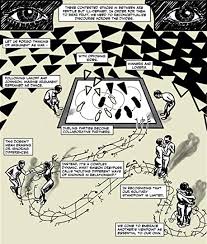
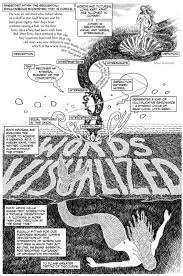
And here are a few pages.
I hesitated to read the book for a long time, but now I am reading two other graphic novels (both biographies of scientists). Unflattening will take your mind places it has never been before.
Enjoy!
My books of 2021:
Thursday, January 6, 2022
January 6, 2021, the End of Democracy in America
From the beginning of my military service nearly 50 years ago, until the last my last day in the Army in May 2016, I attended dozens of change of command ceremonies. After the flag is passed the new and out-going commanders often make a speech. Probably one in three of those speeches made a sincere nod to the American tradition of the peaceful transfer of power.
For the mostly conservative officers taking or relinquishing authority, they linked themselves to a 200-plus year American tradition--a hallmark of American exceptionalism.
But that ended one year ago today when the 45th President sent a mob to overturn the election he just lost. The coup d'etat was mere minutes from success. Hundreds of Trump supporters were screaming to kill Mike Pence. If they had managed to stop the vote, the election could have been thrown into the House of Representatives. That is the last possible place in which a disputed election can be decided according to the Constitution.
With one vote per state, Trump would have taken the election.
All of my adult life I had an implicit belief in progress in America: more rights for more people. The racist rednecks would recede, I believed.
With Trump's nomination and election, my belief cracked. After Charlottesville it was shattered. With January 6, it was gone. The end of democracy was only a matter of when.
America no longer has a tradition of the peaceful transfer of power. I voted for Joe Biden and hoped normal order could be restored in America. One year later, the democratic party is fighting about infrastructure and social programs and has done nothing to fix the electoral count act or secure voting. The Republicans are running MAGA candidates all over the country to get control of election counting. How much does voting really matter if the Republicans are in charge of counting.
In 2016, 63 million Americans voted for a failed casino owner who played a business man on a game show. In 2020, 74 million Americans watched a lying buffoon for four years and said they would like four more. The people who claim most publicly to be followers of Jesus (Love your neighbor; Love your enemies; turn the other cheek) worship Trump much more fervently than they follow anything Christ ever said or did. I have read and re-read the New Testament. Few people who have ever lived are less like Jesus than Donald Trump.
January 6, 2021, was a dress rehearsal. The command performance is three years away. In 2025, there will be no need for a mob to attack. The criminals will be in the building. They will use the power entrusted to them by the Constitution to end democracy.
The Roman poet Horace fought to preserve the Republic during the Civil War after Julius Caesar took power and was murdered. The Republicans lost. Horace was wounded and lost everything. When he recovered, he knew the Republic was gone, so he made peace with his circumstances and became a poet, living the best life he could.
My Books of 2025: A Baker's Dozen of Fiction. Half by Nobel Laureates
The Nobel Prize In 2025, I read 50 books. Of those, thirteen were Fiction. Of that that baker's dozen, six were by Nobel laureates ...
-
Tasks, Conditions and Standards is how we learn to do everything in the Army. If you are assigned to be the machine gunner in a rifle squad...
-
The Remains of the Day by Kazuo Ishiguro Kazuo Ishiguro’s The Remains of the Day is, on the surface, a beautifully restrained novel about...
-
On 10 November 2003 the crew of Chinook helicopter Yankee 2-6 made this landing on a cliff in Afghanistan. Artist Larry Selman i...