Wednesday, October 30, 2019

Paris Training Race and West Along the Seine


Today I am back in Paris and riding longer distances getting ready for Israel. I rode 42 miles from the south side of Paris to the daily training race at l'hippodrome in the southwest of corner of Paris.
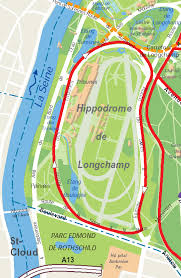
After an 8-mile warmup ride, I joined the with a small group going about 18mph. A half-lap later a faster group went by so I sped up and joined.  At the end of that lap, six guys went by going even faster, so I sprinted onto the end of that group that was averaging 22mph.

I stayed with them for three laps.  I was using Strava so riding with this fast group meant I set a half dozen personal records, and I moved up to 9,500th of 19,500 riders who set times on the two-mile oval.  I also moved up to 43rd among the 140 riders who set times in the 65-69 age group.

After five laps I turned off and made a tour of my favorite towns west of Paris. I rode up and over Mont Valerian through the town of Suresne. I used to stay there when I was in Paris on business 20 years ago because I could wake up early, roll down the hill and ride the daily training race.

After Suresne, I rolled down the long hill into Rueil-Malmaison. The company I worked for had an office there. It's a lovely town on a bend in the Seine.  After that I rode west along the Seine to Saint Germain-en-Laye. This town has an amazing park and Hotel d'Ville and is the setting for the novel Paris in the Present Tense by Mark Helprin--my favorite book by one of my favorite authors.


I rode back through Chatou and stopped for lunch a Maison Fournaise. I'll write a separate post about that.  Paris is a lovely pace to ride.


Tuesday, October 29, 2019

Visiting the Bastogne War Museum and the City

A Sherman tank hit on the right side. Inside the tank there are holes and gouges in every surface and part.  The crew was cut to pieces when their own armor became projectiles that ricocheted around the turret and hull.

The Bastogne War Museum honors the soldiers who fought the last Nazi offensive to a standstill in the cold woods of Belgium and refused to surrender when surrounded.  On this 75th Anniversary year dozens of celebrations will mark significant moments in the battle, beginning in November and continuing into 2020. 

A complete list of all the events and photos are on the museum website here.

For me the tank in the photo above reminded me of the fate of so many tank soldiers. When armor piercing shells blow a hole in armor plate, the armor itself becomes the shrapnel that ricochets inside the tank, killing and maiming the crew. 

M45 Quadmount antiaircraft gun used by the American Army with variants like this one used in a ground installation or mounted on half tracks.

 The museum has a large display on the history of The Holocaust.

This Sherman tank with its bright US Star on the side led me to wonder if the German gunner who hit the tank above used the star as an aiming point.

The commander of the surrounded soldiers of Bastogne was asked to surrender by the attacking Germans.  His reply was "Nuts!" He became famous for that reply and holding out against the attackers.  On his Wikipedia page that commander is identified as General Anthony Clement "Nuts" McAuliffe

Sunday, October 27, 2019

Tanks Painted in Protest? As long as it's not My Tank!


 A Sherman tank in front of the Bastogne War Museum 
painted by a street artist to honor victims of violence.

In front of the museum in Bastogne is a temporary display of art from the fall of the Berlin Wall--30 pieces of wall painted to commemorate freedom. An M4 Sherman tank in front of the museum was also repainted to remember the victims of war and violence around the world.  The other tanks on display in the museum are, of course, painted as they were during their wartime service.  

Seeing a Sherman repainted by a street artist in front of a war museum was jarring.  Should a war machine be repainted as an anti-war protest?
  
Soviet tanks repainted in rainbow and pink as 
anti-war protests.

I realized I did not mind seeing former Soviet tanks painted pink or with love symbols. The Soviet Army was my Cold War enemy. They lost. So defacing their tanks was okay.

But seeing the Sherman tank painted in protest made me uncomfortable. That was an American tank. 

Then I remembered the mixed feelings I had just a week ago when I saw American-built M60 tanks, the tanks I served on in the Cold War, rolling into Syria.  More than 2,000 of the 3,000 tanks fielded by the Turkish Army are M60s.  The tank I served on was part of the attack against the allies Trump abandoned.  I did not like seeing what could have been my old tank rolling across the desert in service to a dictator. 

And then I thought of why tanks are painted in protest and as monuments and memorials.  Tanks are used as targets or monuments or left to rust because they can't be recycled. Armor plate costs more to metal than the recovered metal is worth. So tanks can't be melted down to make Mack trucks or Mercedes road cars. 

Tanks are war machines.  It would be best if unneeded war machines could be reused peacefully, but since they can't they will be monuments or palettes for protest for centuries to come. Armor plate a foot or more thick won't rust away anytime soon. 

Alexander Hamilton by Ron Chernow: A Great and Complex Founder of America

Ron Chernow ’s Alexander Hamilton is one of those rare biographies that does two things at once: it resurrects a historical figure in full ...