Monday, May 22, 2017

Field Guide to Flying Death: A Gun Wrapped with an Airplane


The slowest and most nearly perfect aircraft flown by the U.S. Air Force is the A-10 Thunderbolt II "Warthog" ground support fighter plane.  This amazing aircraft entered active service during my first Army enlistment in the 1970s and remains in service now--the most beloved of USAF planes by ground troops taking enemy fire.

Most fighter aircraft are designed first to fight other aircraft in air-to-air combat, but they also can support ground troops.  Anyone who has used a carving knife to serve butter, or a butter knife to carve a roast knows that specialized tools work the best.

The Warthog was designed for ground support. Nothing else. It's huge turbofan engines allow it to take off with more than 10 tons of rockets and missiles plus 1,200 rounds of cannon ammo for its legendary gun, but the Warthog has a top speed under 400mph and cruises not a lot faster than a World War II bomber.

The GAU-8/A 30mm Gatling Gun 

The "Hog" was designed to "loiter" over a target, firing its cannon, dropping bombs, launching rockets and missiles, and importantly, flying just above the forward battle area, waiting for observers on the ground to identify targets.

A-10 firing its 7-barrel gun with a firing rate of 70 rounds per second.


High-performance jets from the Vietnam-era F-4 Phantom to the current F-15 Eagle and F-16 Fighting Falcon are supersonic aircraft that drop bombs and fire missiles on a target, but they can't hang around. The Phantom flew so fast that some pilots lowered their landing gear and extended flaps just to slow down over the target.  The Hog can put fire on a target then circle back to the target area waiting for the next opportunity to attack, or to see who survived the first strike.

During the Vietnam War, frustration with Phantoms flying in, attacking and blazing away led to deploying the A-1 Skyraider, taking this big, propellor-driven aircraft out of semi-retirement from Korean War service.  The A-1 and variants carried four 20mm cannons or eight .50 caliber machine guns and could be armed with up to four tons of rockets, bombs and missiles.  Like the Hog, it could loiter. Unlike to the Hog it was not very maneuverable and vulnerable to ground fire.

A-1 Skyraider 

Hog pilots are wrapped in a titanium pod, shielded from small arms and some larger arms.  The twin-engined, twin-tailed Hog can fly with an engine failure and big chunks of the wing and tail shot off.

The Hog was slated to be replaced by the F-35 Lightning II. This Swiss Army Knife aircraft is supposed to do everything. But the F-35 costs more than $200 million each, an A-10 costs a tenth of that.  The A-10 is now scheduled to begin phased retirement in 2022 and remain in service until 2040.


Wednesday, May 17, 2017

Field Guide to Flying Death: Rockets and Missiles on the Apache Helicopter

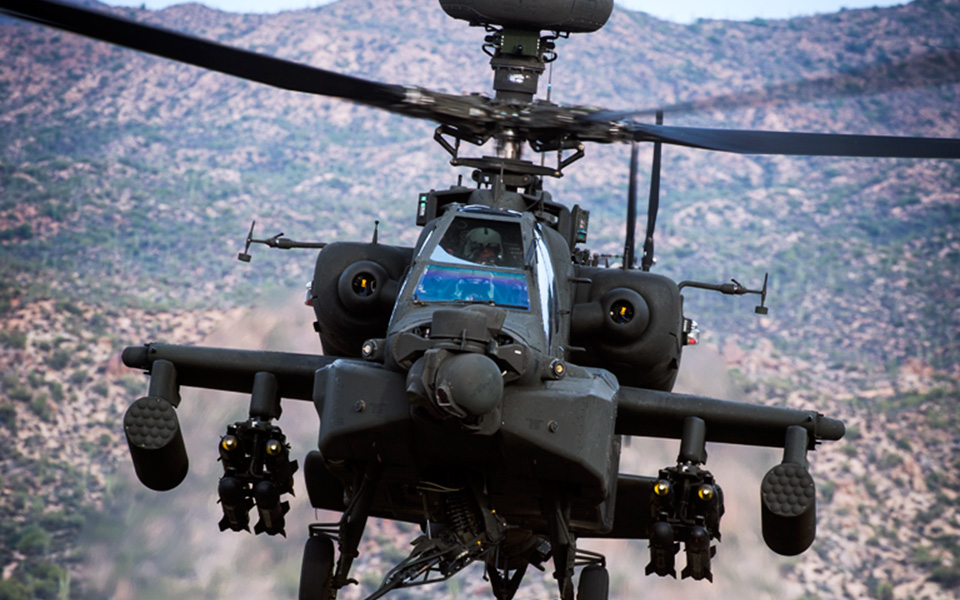
Apache Longbow Helicopter 38 rockets and eight Hellfire Missiles under its stub wings.

Death flies in many forms. Two weapons very often confused are rockets and missiles. In the broadest terms, missiles follow a guidance system to their target. Rockets are pointed at the target, fired and follow a ballistic path, gravity and wind resistance, to the target.

A missile is a guided rocket: a rocket is an unguided missile. 

The difference is similar to the difference between smart bombs and dumb bombs.  When released from an aircraft, smart bombs fall to their target but correct their course. Dumb bombs fall and hit wherever their ballistic path takes them. 

A good example o the difference between rockets and missiles is the basic load of the Apache attack helicopter. In all of its various models, the Apache carries both rockets and missiles.  The standard load is 38 rockets, 19 per pod on each side of the aircraft, and eight Hellfire missiles. 

Four Hellfire Missiles and a fully-loaded rocket pod. 

I watched Apaches fire salvos of Hydra 70mm rockets. The pilots point the aircraft at the target and release pairs of rockets, one from each pod, at the target.  The rockets blast from their tube to a speed nearly a half-mile a second, then fly unpowered up to five miles to their target. 

Hellfire missiles were originally designed as tank-buster missiles. They have a dual warhead in the nose with an armor-piercing shaped charge. When fired, it blazes to about 1,000 mph then flies up to five miles locked on the target. If the target moves, the guidance system steers the missile to the target. 

So why would fire rockets when missiles will track a moving target? Cost.  An Apache helicopter with a full load of 38 rockets and eight missiles has a million dollars in munitions hanging on its pylons: $900,000 worth of Hellire missiles at $115,000 each and $100,000 in rockets costing $2,800 each.  A full load of 38 rockets costs less than just one Hellfire missile. 

Rockets are dumb, missiles are smart, but if either one hits, the target is destroyed. 

Everything That Flies is Ballistic

Every flying object from a football to a Saturn V rocket follows a ballistic path through the air as soon as the ball leaves the quarterback’s hand or the rocket burns all of its fuel.  Rockets, missiles, bombs, bullets, and every sort of ball follows a ballistic path once it is thrown, fired, kicked, hit or launched. 

For Americans, the path followed by a long pass in a football game is a beautiful example of a ballistic path.  The thrown ball leaves the quarterback’s hands at about thirty degrees and climbs rapidly in a nearly straight path to its maximum height. After it reaches maximum height, the spinning football drops rapidly into the arms of the running receiver.

Rockets, missiles bullets and bombs follow the same path with a higher starting speed.  Until the advent of cruise missiles, the term ballistic missile was redundant.  The fuel burned in seconds and from then on, the missile was on a ballistic path all the way to its target. 

Cruise missiles are jet planes with one high-explosive passenger in Seat 1A.


-->

Sunday, May 14, 2017

Field Guide to Flying Death: Artillery


Royal Thai Army firing an M198 Howitzer, 155mm. 
The 90-pound projectile jumps from the gun at nearly a half-mile per second. 
It can hit a target 18 miles away in less than a minute.

With so many wars either ramping up or about to begin, I decided to write about all the many, many projectiles that I have fired, I have seen fired, or have been fired at me.  My first post will be about artillery, then I will talk about bombs, bullets, ballistic missiles and guided missiles. I will also talk about how the various forms of flying death start their flights, whether from a gun, an airplane, a submarine or a ship.

Artillery comes in many shapes and sizes, but the M198 is typical. It fires a 90-pound shell anywhere from direct-fire right in front of the gun to nearly 20 miles away. A good crew can fire two rounds per minute for hours or up to four rounds in a minute for a short period. The most common round is HE, High Explosive: 90 pounds of detonator, explosive and a case designed to break into sharp fragments.  The round leaves the gun at more than 2,200-feet-per-second or almost a half-mile per second. The shell can fly to a target 18 miles away in less than 45 seconds.  The kill radius of the blast is 50 meters, the casualty radius is 100 meters.

Drop a 155mm shell from an M198 on a football field in the middle of the fifty-yard line and both teams including the coaches and players on the bench, the camera crews, the refs and everyone with midfield seats near the field will die. Injuries from shrapnel and blast will maim hundreds more in the stands and blow all the windows out of the fancy skyboxes.

But the most important specification is the price.  A brand new howitzer costs just over a half-million dollars.  High explosive rounds cost about $500 each.  So a million bucks buys a brand-new howitzer and a thousand rounds of ammo.

Relative to guided missiles, artillery is cheap and deadly. Dictators on a budget who cannot afford aircraft and high-tech missiles can buy lots of artillery.

And they do.

This cheap, traditional weapon is the key to why the malignant lunatic leader of North Korea holds the civilized world right by the short hairs. Kim Jong Un has thousands of artillery pieces and rocket launchers pointed at Seoul, the capital of South Korea.  If we attack North Korea, his guns start firing at Seoul.  More than 20 million people live in the Seoul metropolitan area and tens of thousands of Americans are also in range of those guns.

Unlike long range missiles and aircraft, there is nothing that can stop an artillery shell in flight. And there is no effect early warning system.  If North Korea starts firing artillery at Seoul the first salvo of shells and missiles will hit in one minute after the command to fire.  Crowded streets, markets, tall glass buildings, apartment complexes, and stadiums are perfect artillery targets.

When armies want to stop artillery, they have to find a way to blow up the enemy guns. Guns can be attacked by aircraft and by artillery, called counter battery fire. But there are too many North Korean guns.  Even if we win a war against North Korea, Seoul would be rubble.

Although accuracy hardly matters when firing artillery against civilians on streets and in glass buildings, modern guns are very accurate.  A well-trained crew will put their first round they fire within the 50-meters of the target at a distance of 20 miles. With a good observer guiding the crew, the next round could hit a golf cart.

Artillery is cheap, effective, mobile and terrible.


Breath by James Nestor: We All Breathe Badly!!

As a book, Breath works because it sneaks physiology in through storytelling. Nestor uses explorers, monks, athletes, dentists, and oddbal...