Thursday, March 30, 2017

Bullets, Bikes and Rotor Blades: Random Motion, Perfectly Predictable


Bullets rip from the barrel of modern rifles at more than 3000 feet per second.  Tanks fire armor-piercing shells that travel nearly twice that speed, just over a mile a second.  Rotor blades on helicopters sweep the air at a constant speed, but a small  change in the pitch (tilt) of the blades causes the ‘copter to rise, drop, hover or hurtle through the air at more than 100 knots.


Each of these complex motions is almost perfectly predictable moving through an utterly random medium: air.  The atmosphere, from sea level to stratosphere, is nothing but randomly moving molecules.  The molecules of air are vanishingly small,  so each cubic foot of air has about 30 sextillion molecules (3 with 22 zeroes) of air in it at any moment.

Since air is mostly nitrogen and oxygen, most air molecules are just under a millionth of a millimeter long. These tiny particles move in random directions: up, down, left, right and everything in between at speeds around 1000 miles per hour at room temperature and normal atmospheric pressure. 


And yet.

The collective motion of hundreds of trillions of individual molecules is so predictable that a 95-pound artillery shell fired from a 155mm cannon can hit within meters of a target ten miles away.  A 105mm tank cannon firing a practice SABOT round can make  will punch a perfect 40mm hole within inches of the middle of a one-meter circle a full kilometer away. In 1976, my gunner made a smiley-face triangle with three rounds while we were zeroing our main gun. 

If random motion meant changes in wind resistance, gunners would never be able to fire with inch-perfect accuracy.

Every week I coast down a ¾-mile-long hill. At the top of the hill are two big wind-power generators.  A mile away from the hill I check the direction the blades are facing and their speed. I know before I get to the hill what my speed will be at the bottom within less than 5mph. The difference comes from how much draft I get from other cyclists.  In the distance down that hill, my bicycle and I pass through 15 cubic feet of air for every foot we move down the hill.  So from top to bottom the bike and I pass through 50,000 cubic feet of randomly move molecules of air, billions of sextillions of molecules of air.


And yet.

The motion is perfectly predictable.  Any single molecule of air might be racing ahead of my bicycle at 1000mph or it might get passed by a bullet or a cannon shell. But the collective motion of all those molecules is wind resistance. And wind resistance is as predictable as electrical resistance in a wire fluid resistance in a pool of water. 

The world is full of randomness at every level from atoms to stars and yet the universe is so stable that the greatest theories of science are based on permanency across millennia of time and light years of space. 

This is beauty we are immersed in every day. 

If we could see air molecules move, it would look like the tracers from a hundred monkeys firing a hundred machine guns while swinging through trees. 

Nature is often this way. A surprise. Not at all what we expect and somewhere beyond amazing. 


Sunday, March 26, 2017

Obsessed With Ribbons: Civilian and Military

For Illustration Only! This is what four ribbons looks like on a conference badge.
I actually merit no ribbons!

The selection of possible ribbons.

Today I worked in the registration area at an engineering conference.  I helped people find the ribbons they were supposed to wear as conference participants.  Most of the participants knew which ribbons if any they were supposed to wear.  Most people wore none.  The most common ribbon was "Speaker" followed by "Fellow."  

But about one in twenty were entitled to multiple ribbons. Most had been doing this for years and knew which ones they should wear, but at one point a group of four men and women showed up who were very excited about their multiple ribbons and upset that the ribbon "Chair" was not available.  Each of these avid ribbon wearers were the Chair of something and were upset that ribbon was not on the ribbon table. 

Since I had no useful information about where they could get their Chair ribbons, they looked for the manager of registration to see if there was a not a special stash of Chair ribbons in a secret place.  Then they discussed the order of their ribbons and how many each person was entitled to. I did not laugh out loud, but I am sure the smirk I wore was visible.  

In the Army there are a few soldiers obsessed their awards who make sure they receive every award they are entitled to.  Most soldiers are indifferent and take awards very lightly.  But a few want to be sure they receive every award of the Pennsylvania Recruiting and Retention Medal if they have met the requirements for that particular medal.  

In the Army every soldier is required to display all medals they have earned and for which they have orders, so some soldiers become expert in their ribbons because it is part of proper wear of the uniform.  

At an engineering conference, no one is required to wear ribbons, so the men and women who were hoping to add four or five ribbons to their badge can't say they have any reason except badge vanity. Of course, vanity can show up anywhere: in the Army, at an engineering conference, or on the runway at the Academy Awards.  I just thought it was funny to see ribbons for "Speaker" and "Fellow" and "Chair" treated like a Bronze Star Medal, and Air Medal, or a Croix de Guerre."


Friday, March 24, 2017

Yes, I am Judging You


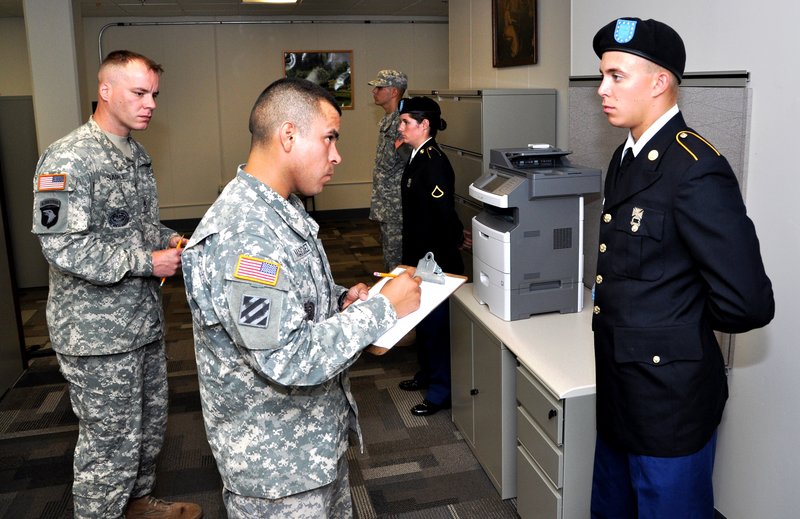
When I tell a civilian that I and every sergeant is a judgmental bastard, they think I am being funny.  I am not.  When I was a sergeant in the Army it was my job to glance at a soldier and infer from his wear of the uniform how much I could trust him and how much he really understood his duties.  And when I recognized a fault it was my job to tell that soldier to correct the fault and check that he did.

One sergeant I served with said, "I tell them how they are fucked up and how to un-fuck themselves."

In any area of life in which experts are in close contact with amateurs, the experts will be judging the amateurs. Expertise is tough to come by. It takes hard work.  If Malcolm Gladwell is right, it takes 10,000 hours of practice to truly master a skill.

Because written communication has become so much more common and so much more public on social media, I read people saying that their grammar doesn't matter.  It is their brilliant thoughts we should pay attention to.  Soldiers believe this rubbish too and say so on social media.  Although they will judge another soldier when one insignia 1/16th-inch out of place, they somehow think their idiotic self-expression gets a pass. It doesn't.

I cannot look at a badly worn uniform without judging the wearer. I cannot look at an ill-constructed sentence without thinking it is the careless expression of muddled thoughts.


Breath by James Nestor: We All Breathe Badly!!

As a book, Breath works because it sneaks physiology in through storytelling. Nestor uses explorers, monks, athletes, dentists, and oddbal...