Friday, January 20, 2017

The Rommel Effect


On social media and in news commentary, there is near universal agreement that making General James Mattis Secretary of Defense if a great thing for America and the Trump Regime. Not only is Mattis arguably the best living general in America, maybe in the world, but he is also seen as willing to stand up for what is right.

But the meteoric rise and fall of the World War II German General Erwin Rommel shows that great generals can make ultimate defeat worse. And it shows that soldiers are lousy conspirators.

The common view of the first year of World War II is that the British and French armies were routed and defeated in six weeks by a superior German armored force using Blitzkrieg tactics. The truth is, the invading Germans were outnumbered and outgunned by the defenders of France. They won because Erwin Rommel commanded 7th Panzer Division at the front of the invading German Army carrying out a brilliant invasion plan.

The British and French had a combined 3,000 tanks, all of which had cannons capable of destroying any of the German medium tanks in the invasion force.  The Germans had 2,000 tanks, hundreds of them armed with just machine guns.  But the Germans concentrated nearly all their armor on a 20-mile invasion front, while the British and French spread their tanks from the Swiss border to the English Channel.  Rommel punched through the allied lines. He personally waded into rivers when his engineers were making bridges for his tanks.  Rommel broke through the allied lines and captured huge formations.

Without Rommel carrying out a brilliant invasion plan by General Heinz Guderian, the allied army could have stopped or slowed the German advance and dragged out the war in France. The great early success of Rommel, Guderian and the German Army led Hitler to invade Eastern Europe and the Soviet Union.

Four years later when Allied armies were back in France after D-Day and Soviet armor was in Poland headed for Germany, Rommel joined a plot to assassinate Hitler. Rommel took his own life after being caught.  Honorable soldiers are lousy conspirators.

General Mattis could be great for America. His job is to make the American military the best weapon possible. He could make the American military an even better fighting force. But Trump, not Mattis decides who that weapon will be pointed at, just as Rommel fought where Hitler told him to.

Generals decide HOW to fight, not WHO to fight.

Wednesday, January 18, 2017

Book Report 2016, Part 6, Politics

Of the fifty books I read in 2016, just four are in the category Politics, but every book about war is to some extent about the politics that leads one nation to fight with another.

The first book I read on politics was New Czar: Rise and Reign of Vladimir Putin by Steven Lee Myers.  This long, thorough book traces the entire life of Putin and the improbable path to his present place at the among the top world leaders.  He has been on top of Russian politics for all of this century, all the more amazing because he was truly as another biography calls him The Man Without a Face by Masha Gessen. Masha Gessen's book is on my list for 2017.

Boris Yeltsin picked Putin for leadership in 1999 partly because Putin was the only man in Yeltsin's government who was not on the take. The year before, Putin's house burned down. While it was burning Putin ran back in the house to get a briefcase with 5,000 rubles in it.  After the collapse of the Soviet Union in 1991, many top government officials were taking millions from the failing economy for themselves. If Putin would risk his life for just 5,000 rubles, he could not have millions stashed in Switzerland.  But the corruptions of power corrupted Putin as power corrupts everyone. And now Russia is ruled by an authoritarian government keeping some appearance of democracy.  Putin now is reputed to have more than $30 billion stashed in overseas accounts.

In the spring I re-read The Prince by Machiavelli.  I just got a new translation and will be writing about that later in the context of military leadership. I use the Prince to keep score on the leadership of Presidents.  In a few months it will be interesting to compare Presidents Obama and Trump on how they followed (or not) Machiavelli's council.

In the Fall as it began to look as if Trump had a chance to win, I re-read Why I Write by George Orwell.  In the main essay of this short book, Orwell says that everything he writes will be to bring about Democratic Socialism in Great Britain. Orwell lived only a few years after this essay was published in 1946, and his dream never came pass.  At the end of this volume is "Politics and the English Language" Orwell's most famous essay describing the language used by "Big Brother" in Orwell's book 1984. The whole text of the essay is here.  In the past 30 years since I first read the essay, I heard echoes of Newspeak in many political statements.  But now, the time of Newspeak has fully arrived.

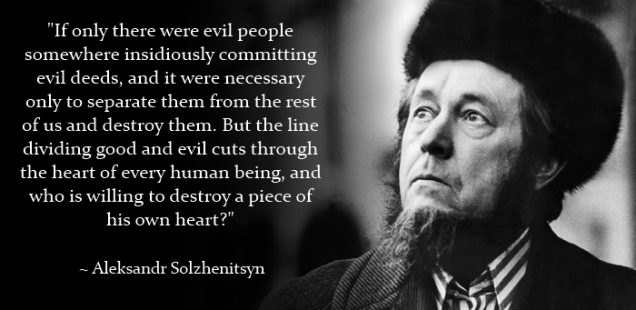
Which brings me to A World Split Apart, the dual-language edition of Aleksandr Solzhenitsyn's address at Harvard in 1978.  Solzhenitsyn had recently come to America, exiled from the Soviet Union for his books chronicling the horrors of Soviet life.  Yet his address is not a grateful refugee basking in freedom after a decade in a Soviet GULAG after heroic service in World War II.  Solzhenitsyn says the west has sold its soul for materialism and crushing its own soul for comfort and wealth.  He lived in seclusion in Vermont for almost 20 years, then returned to Russia after the fall of the Soviet Union.

This year, I will be reading Machiavelli and a biography of Putin as I noted above.  I will also be reading about the years leading up to The Holocaust. Every genocide begins when some minority is declared non-persons by the majority.  All through history mass murder and deportation begin with revoking rights, then revoking citizenship. I will be looking for that in 2017, because that is where the next war will follow.


Thursday, January 12, 2017

Forty Years Later: U.S. Armored Brigade from Fort Carson Reinforces Europe


Today an Armored Brigade from Fort Carson, Colorado, arrived in Poland as a show of force to Russia.  More than three thousand mechanized soldiers will spread across Poland and the Baltic States as well as Romania, Moldova and Hungary to the south.

The unit deployed is the 3rd Armored Brigade, 4th Infantry Division, including 1st Battalion, 68th Armor.  

Forty years ago, in October 1976, the 4th Brigade, 4th Infantry Division (Mechanized), including 1st Battalion, 70th Armor was sent to Wiesbaden, West Germany, as a show of force against the Soviet Union.  I was a tank commander in Bravo Company of the 1-70th Armor.  

Today's news was certainly deja vu for me. Forty years ago and today, troops from Fort Carson waving a finger in the face of the Russian/Soviet leader.  One big difference is that all the countries where the 3rd ACT, 4th ID will be training are places that were under Soviet control 40 years ago.  

In a further coincidence, after I left active duty, I joined an Army Reserve Armor unit: Company A, 6th Battalion, 68th Armor.  All of my service in armor was in these two units.  Now they are together in former Soviet states, resisting Russia.  


Hannah Arendt’s On Revolution: The Book That Explains Why Revolutions Keep Failing

  Hannah Arendt ’s On Revolution  is the book people come to later, after reading  The Origins of Totalitarianism  and Eichmann in Jerusalem...