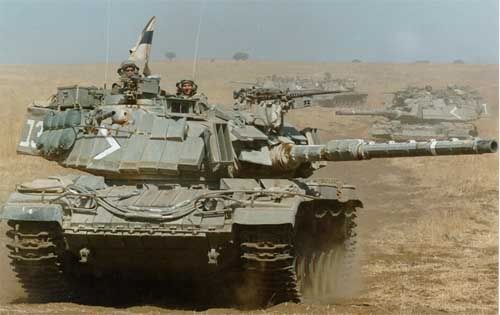
In May of 1984, I had a total of eleven years and two months of active and reserve service. At the time I was a staff sergeant, a tank section leader and had just filled out the application for Officer Candidate School (OCS).
At that critical point, I had to decide whether to stay and finish 20 years or more of service, or get out, grow a beard and be a real civilian.
SPOILER ALERT! I grew the beard.
How did I make this momentous decision to leave the military with nine years till retirement?
Because of advice from my uncle Jack, the only other recent veteran in my family. Jack retired in 1978 from the Air Force after 20 years of service. He had three full tours in the Vietnam War and three temporary duty (TDY) assignments to that war that stopped short of the 180-day line of counting as a full tour. He flew back seat in an F4 Phantom fighter and was also a navigator in a refueling plane. When he was not in Southeast Asia, he was often assigned to Thule, Greenland.
Jack said that if I stayed in I should go to OCS. But if I stayed in I would be in a desert war before I got out. More importantly, he reminded me that with a reserve retirement I get no money till age 60 and I would be subject to recall to duty any time until age 60 if I was enlisted, age 63 if I was an officer.
He went on to describe the most unhappy people in the Vietnam War as retired aircraft mechanics reactivated in their 50s and taking incoming mortar fire while trying to fix aircraft.
Jack said, "If you take the retirement, here's the choice. You either go to war or forfeit all pay and benefits for life."
Wow!!
With all that clarified, I left the military, grew a beard and got a job with an ad agency. You may think I could have gotten the job anyway, but not really. During the three years I was in the 6th Battalion, 68th Armor in Reading, Pa., I worked on the loading dock at Yellow Freight near Lancaster, Pa. I was a Teamster. With a union job, I could simply sign out for reserve duty any time I needed to. As a section leader, I had monthly meetings on Wednesday nights, drill set up on Friday, and other additional duties beyond reserve weekends. In a union job, the extra Army time was no problem. In a white-collar job, that meant choosing between work and Army.
Most reserve and National Guard leaders are government or union workers.
My decision was rational, but the irony is sadly funny. At 54 I re-enlisted. At 56 I go to the desert war Jack predicted and at 63 I get out one year short of a retirement and three years past the date I would have started receiving my Army reserve retirement pay.
The 68th Armor did not mobilize for the Gulf War, and not many tankers were activated for Iraq and Afghanistan. As a reserve tank officer, I would almost certainly have missed the Gulf War, and most likely would not have gone to Iraq or Afghanistan since I would have had almost 30 years service by then.
As a military career move, I should have stayed in my reserve unit. But if I did stay in the reserves, I would have had a lot of reasons to either stay in the Teamsters union or try to get a government job. I could not have had the world-traveling civilian career I had during the 90s and first decade of the 2000s.
Jack and I talked in 2005 about all the places I had been in the world, versus all the places he had been with the military. My job took me to the capitals of every thriving economy in the world. The places I went most were Paris, London, Hong Kong, Singapore and Sao Paulo. Jack's big destinations were war-torn Asian airfields with winters in Thule, Greenland.
I would have liked a military retirement, but the travel with my civilian job really was amazing--and incompatible with reserve service.