Thursday, July 28, 2016

Soviet Armor vs. American Armor, Israel 1973


In July and August 1975, I went to the U.S. Army Armor School in Fort Knox, Kentucky, after three years in missile weapons testing.

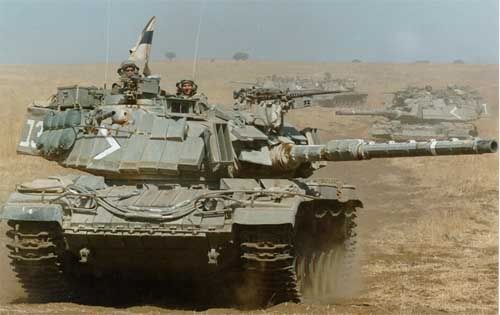
We learned the basics of armor and about our tank, the M60A1.  We also learned about a serious flaw in our tanks that was fixed at great cost by the Israeli Army.  The Israelis fought and defeated the armies of Egypt, Syria and Jordan using the M60A1 among other tanks.  It turns out the hydraulic fluid in our tanks was prone to catch fire.  After the Israelis lost crewmen to these fires, the hydraulic fluid was changed.

We also learned how important mechanical reliability is to combat tank crews.  The Arab countries used Soviet tanks, primarily the T-55 and T-62 main battle tanks.  We learned the difference between "live" and "dead" track.  Soviet tanks used dead track, like bulldozers that does not use rubber bushings.  In hard use, especially at high speeds, dead track is more prone to break.  According to one report, the Syrian Army lost one-fourth of its tanks before they reached the battle in the Golan Heights due to automotive failure.

After the 1973 War, the Israelis installed American-made drive lines in captured Soviet tanks to make the Soviet armor more reliable.

To people who have never trained and lived in a tank, they can seem like the indestructible behemoths of movies.  But real life in a tank is a life of wrenches and rags.  As a tank commander of one of the most reliable tanks of its time, my crew and I spent five hours or more maintaining our 54-ton tank for every hour of operation.  Each of the 80 track blocks on each track were held together with a center guide and two end connectors.  Each of the 160 center guides and 320 end connectors could work loose and had to be checked, often.  The center guides ran between six pairs of road wheels, three pairs of return rollers, the drive sprocket and front idler wheel for adjusting track tension.  Each of the wheels had inner steel plates bolted to the aluminum wheels.  The road wheels were attached to torsion bars.

We tightened bolts all the time.  Our tanks would received major service at 6,000 miles of operation, usually including a refurbished V12 diesel power plant and transmission.

And our tanks were so much more reliable than the Soviet counterparts that the Israelis ditched their drivelines and installed American-made drivelines to make the Soviet tanks more reliable.

War shows strengths and weaknesses.  Reliable, effective armor is definitely an American strength.


Monday, July 25, 2016

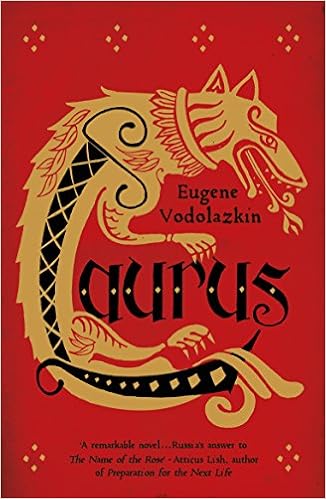
Laurus, Book 19 of 2016: A Tale of Old Russia that Stretches to Florence and Jerusalem


Eleven of the books I have read so far this year are by Russian authors writing about life in Russia from the present back through the last two centuries.  This book goes several centuries further back into Russian history.

Laurus by Eugene Vodolazkin showed me a Russia that I have seen only in fleeting glimpses. We follow the title character, Laurus, from when he loses his parents as a child until the end of his long life as a healer and a holy man between the mid 1400s to the 1520s. 

This is a medieval book by setting and by the parade of wretched, reverent, hopeful, fearful and foul characters that people the pages of this wonderful book.  After Laurus (Arseny in his early life) loses his parents he moves in with his grandfather, a healer named Christopher.  Arseny follows his grandfather and becomes a healer, but as his life progresses, Arseny relies less on the herbs and lore of Christopher and more on the healing gift he has from God.

Arseny becomes adept at healing plague victims.  He heals a young woman from far away named Ustina.  They fall in love and live together.  Ustina gets pregnant then she and their son die in childbirth. 


At that point, Arseny becomes an itinerant “Holy Fool” in the city of Pskov. (Pskov is the northwest corner of modern Russia.)  He shares Pskov with two other Holy Fools.  One is Holy Fool Foma, who is very territorial.  Foma is one of the many brilliant bits of comic relief we get on the long life of suffering of our very Russian hero Arseny/Laurus (also at various times Ustin and Ambrosius). 

In the middle of the book, we meet Ambrogio, an Italian from Florence with a gift of Prophecy as strong as Arseny’s gift of healing.  Ambrogio is convinced the world is ending soon and the only place he can get exact knowledge of the coming Apocalypse is in Pskov.  In 15th Century Florence, Ambrogio finds a trader willing to teach him Russian.  Ambrogio learns Russian with an accent perfect for Pskov in short order and sets out for Pskov.

In Pskov, Ambrogio meets the mayor.  The mayor introduces the Italian to Arseny and bankrolls their trip to Jerusalem.  All the horrors of the road befall them.  Ambrogio is killed near Jerusalem; a sword but lives and return to Pskov slash Arseny. 

Late in life Arseny goes to a monastery and finally lives in a cave.  He takes the blame for a sin he did not commit and dies rejected by thousands who he healed.  But when he finally dies, more than 100,000 people mourn his passing. 

Laurus shows from beginning to end that the life of true faith, the life truly given to others, means poverty, rejection and suffering.  Arseny, like the Bishop in Les Miserable rejects this world out of habit and choice.  Arseny, like the Bishop, illustrates the passage called the Beatitudes in the Gospel of Matthew.  I am adding that passage at the end of this review. 

Laurus is the Book of Acts set in Russia with the unrelenting suffering of the Apostle Paul set in a colder climate.  Any televangelist who read and understood Laurus would burn his mansion, his private jet and his TV studio to the ground. 

This book shows what the Christian life looks like and it is a good story well told.

Matthew Chapter 5
Seeing the crowds, ohe went up on the mountain, and when he psat down, his disciples came to him.
The Beatitudes
And qhe opened his mouth and taught them, saying:
r“Blessed are sthe poor in spirit, for utheirs is the kingdom of heaven.
“Blessed are vthose who mourn, for they shall be comforted.
“Blessed are the wmeek, for they wshall inherit the earth.
“Blessed are those who hunger and xthirst yfor righteousness, for they shall be satisfied.
“Blessed are zthe merciful, for they shall receive mercy.
“Blessed are athe pure in heart, for bthey shall see God.
“Blessed are cthe peacemakers, for dthey shall be called esons1 of God.
10 f“Blessed are those who are persecuted for righteousness' sake, forutheirs is the kingdom of heaven.
11 g“Blessed are you when others revile you and persecute you and utter all kinds of evil against you falsely hon my account. 12 iRejoice and be glad, for your reward is great in heaven, for jso they persecuted the prophets who were before you.


My Books of 2025: A Baker's Dozen of Fiction. Half by Nobel Laureates

  The Nobel Prize   In 2025, I read 50 books. Of those, thirteen were Fiction.  Of that that baker's dozen, six were by Nobel laureates ...