Thursday, May 19, 2016

General Problem: When the Division Commander Wants Branding


During Annual Training 2014, I had the delightful experience of using my civilian public relations skills as a soldier. The fuelers of the my unit set up a refueling site at the Pottsville Airport.  I called the Pottsville Republican Herald and talked to a reporter who was interested in the military.  I gave him dates and times that he could get pictures and videos of Chinook and Blackhawk helicopters refueling at the airport.

He showed up with a photographer and video cameras.  The commander of the refueling unit showed him all around the site.  The result was a the front-page, above-the-fold story and photos you see above.  I was elated.  I bought a half dozen copies.  The reporter had also posted videos on the newspaper's web site.

SCORE!!!!

The day after the story was published I was in the State Public Affairs Office on Fort Indiantown Gap when Major General John Gronski walked in with a copy of the newspaper in his hand.  I could see he was upset.  The two majors in the office jumped from their chairs to talk to the General who wanted to know how this story was placed.  He was upset that the headline said "National guard trains at airport."

He wanted the headline to say "28th Infantry Division trains at airport." He wanted "branding" for his unit.

The public affairs officers tried to explain that this was a very positive story on the front page and that we cannot control what a newspaper says in headlines.

FAIL!!!!

The General left a few minutes later because there was nothing that could be done with a newspaper that was already printed.

Some leaders have a good sense of how communications works.  Some don't.  I have worked for civilian and military leaders who knew how public relations works, and for leaders who don't.  Most military leaders I have known are suspicious of the media at best, so the General's reaction was not surprising.

Ten years ago on the best day of my working life I coordinated a story that was most of the front page and half of an inside page of the New York Times "Science Times" section.  It was a literal million-dollar public relations score for the company I worked for.  The story was completely positive.  It was a great story by the leading science historian at the Times.  Most of the staff was elated.

In  the midst of the congratulations and high fives, the grumpy Quaker CFO of the company said, "They don't mention our name until the sixth paragraph."
 
With both the general and the grumpy Quaker, I knew there was nothing more to say.

SIGH!!!!

Shortly after I retired from my civilian job, I took a course in fiction writing at Franklin and Marshall College.  I wanted to learn the mechanics of writing fiction but I also took the course as a kind of mental mouthwash to clean public relations out of my mind and tell the whole truth when I write, at least from my perspective.  Public relations, like lawyering, strongly relies on telling exactly the truth you want an audience or a jury to hear--not the whole truth.


I got paid to do that for 30 years.  Now I can tell the truth as I see, and not get paid.


Tuesday, May 17, 2016

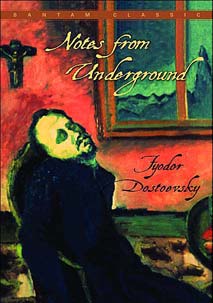
Book 11 of 2016: "Underground Man" by Fyodor Dostoevsky, a chilling portrait of cowardice.

When I first believed in Christianity, I was in the Army in Germany in the 70s.  The only Church was the Army Chapel system.  So I read widely and listened to sermons to figure out what exactly being a Christian meant.  Among the many cassettes I listened to were sermons by southern revival preachers.  After hearing dozens of these sermons I began sense the rhythms and themes that these stirring speeches shared. 

The best sermons began in sin, descended almost to Hell, then rose up on the wings of God’s Grace.  After a while, it became clear that, although every preacher was a terrible sinner, they only committed sins that a conservative southern audience considered manly.  All were fornicators, but they were fornicators with lovely, willing women.  Many told stories of drug use, but more told stories of being drug dealers.  If they drank, they could hold their liquor.  If they fought, they won or were beaten to the point of death by several attackers.  If they stole, they robbed banks and stores and drug dealers.  In other words, they sinned boldly, bravely and in ways that their audiences could admire.  They could repent proudly after a sin well done.

But all real thieves begin their crime careers by stealing from their mother or their sisters and brothers.  Many boys dream of having a half-dozen beautiful devoted lovers, but their reality is looking at lewd pictures in their bed or the bathroom.  None of these confessions included rape, gay sex, theft from loved ones, drunkenly wetting the bed, or getting bitch slapped by a bully. 

In The Screwtape Letters C.S. Lewis says “Cowardice, alone of all the vices, is purely painful—
·      horrible to anticipate,
·      horrible to feel,
·      horrible to remember.” 
Lewis said we can be made to feel proud of most vices, but not of cowardice. 

So the Texas preachers avoided any whiff of cowardice in their confessions.  But in the book Notes from Underground  by Fyodor Dostoevsky the main character is in a downward spiral of cowardice that ends with him tormenting a prostitute he has just had sex with. 

Unlike the Revival Preachers, Fyodor Dostoevsky, shows his readers sin in the full flower of corruption.  The Underground Man boils with rage, but shrinks back from direct confrontation.  He imagines slights where there are none, and simmers with resentment.  He betrays every kindness and finally locks himself in a basement, unable to work or talk to anyone except himself. 

The Underground Man is shabby and filthy, yet vain about his appearance.  He thinks endlessly about how to repay perceived slights, and cannot respond to any kindness except with spite and rejection. 

In every coward who is bullied there is a bully inside him ready to turn mercilessly against someone weaker than himself.  The Underground Man bullies the prostitute because he can.   

My first Russian Literature professor said “Tolstoy shows us God the Father; Dostoevsky shows us Christ loving the least of us.”  The Underground man is weak, a coward and a wretched bully: an actual picture of sin, not the shiny, glossy ready-for-Prime-Time picture of sin I was hearing from the preachers. 

For sin as it really is, Underground Man is painfully good as are Crime and Punishment, The Idiot, and all of the wrenching stories and novels of Fyodor Dostoevsky.


My Books of 2025: A Baker's Dozen of Fiction. Half by Nobel Laureates

  The Nobel Prize   In 2025, I read 50 books. Of those, thirteen were Fiction.  Of that that baker's dozen, six were by Nobel laureates ...