Veteran of four wars, four enlistments, four branches: Air Force, Army, Army Reserve, Army National Guard. I am both an AF (Air Force) veteran and as Veteran AF (As Fuck)
Thursday, April 20, 2017
Dante's Inferno in Iraq: A Podcast
This post is just a link to a podcast on Sectarian Review. The podcast is about the Dead Poets Society Book Group I led on Camp Adder, Iraq. Also on the podcast is a professor who teaches Dante every year.
That group started almost eight years ago in July 2009. Here's the link.
Thursday, April 13, 2017
Ten Years Ago Today: Cold War Soldier Does the MEPS Duck Walk
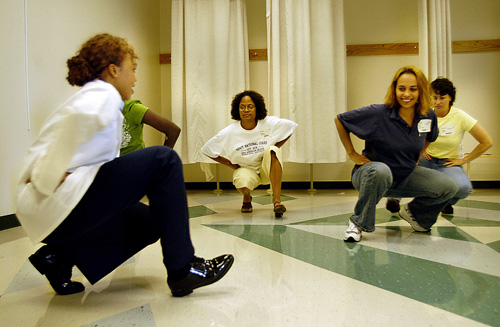
Doctor at MEPS shows recruits how to Duck Walk
Ten years ago, I woke up at 0400 (4 a.m.) with about 40 other recruits to take the physical and the other tests that would allow me to re-enlist. Everybody except me and one other guy were between 17 and 20 years old. I sat with the other Old Guy at breakfast. He was 29 years old, I was 53. We were the old guys.
During that day at MEPS (Military Enlistment Processing Station) we got blood tests and probes stuck anywhere they would fit. I knew all that was coming. But my big worry was the duck walk. We had to squat down and walk across a room, about 20 feet, in a squat, with our hands on our hips.
At the time I re-enlisted, I was an avid bicycle racer. I was in shape, good shape "for my age." But the Duck Walk worried me. I might be in good shape for my age, but the Duck Walk is easy for any reasonably fit 18 year old, not so easy for those of us over 50. As it turns out, it was not so easy for my new 29-year-old friend. We lined up with a half-dozen kids in the third Duck Walk wave and waddled across the room. The other old guy and I grunted, struggled, wobbled but finally made the distance. We were slowest finishers by a lot.
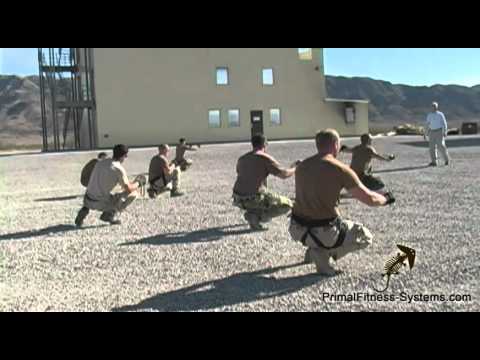
The Duck Walk Outdoors
We passed. We high-fived each other and made the kids laugh, and whisper about WTF the old guy was doing enlisting.
After the needles, latex gloves, turning and coughing and eye charts, we got dressed and went to another part of the building for the aptitude test.
This was the third time I had taken the entrance exam. In 1972 when I first enlisted in the Air Force, and again in 1975 when I re-enlisted in the Army, I took the test. Back then it was on paper. Today it was on a computer. By the time we left the test room and returned to the waiting area, we knew the results. No waiting.
When I walked back to the testing room, the Navy Chief Petty Officer in charge of the test stood up, walked around his desk and shook my hand in front of the group. He said, "You just got the highest score of anyone we tested this year. Congratulations! You qualify for any job in the Army, Hell, any branch of the service based on these scores."
Then he added, "But at your age, there are damn few schools that will take you. But good job!"
I thanked him. He was right. Everything good in the military has an age limit. But I knew that coming in. I was just happy I passed the Duck Walk. Now more paperwork.
Thursday, April 6, 2017
Chemical Weapons: Feeble in War, Powerful Against Civilians
German Captain Fritz Haber gave the command to release chlorine gas from hundreds of cylinders at Ypres in April of 1915. At that moment, chemical warfare became part of the horrors of trench warfare for the remainder of World War I.
Chemical weapons were not used in World War II, or subsequent wars, except the Iran-Iraq War in the late 80s. Military leaders soon found that chemical warfare is less effective than kinetic (bombs and bullets) warfare. With the additional problem that the winners often cannot occupy the territory they take. An area contaminated with Sarin or other nerve agents will take weeks to decontaminate.
While they are not very effective against trained, protected soldiers, chemical weapons work very well against civilians, particularly in cities. Closed, crowded spaces are perfect for chemical weapons. Subways, meeting halls, sports arenas are all perfect places to use chemical weapons.
In 1977, one of my additional duties as a tank commander in West Germany was CBR NCO. I was the Chemical, Biological, Radiation Weapons Sergeant for our unit. Each month I gave and hour-long class in a different weapon of mass murder and how to survive. Although we tank soldiers had a better chance of surviving than ground troops, everyone knew that in a war with gas and nukes and weaponized bugs, we were going to die.
At the end of each class I would yell, "On your feet!" The room stood up and I presented the doomsday scenario of the month. What should we do if our position is hit with a nuclear weapon? Or what should do if we are attacked with artillery shells full of nerve gas, the kind that will kill you even if you get a drop on your skin?
The soldiers answered in unison, "Sergeant Gussman, we will put our heads firmly between our legs and kiss our ass goodbye!"
We walked out laughing, but no one thought these weapons were anything but terrifying. They still are.
Subscribe to:
Comments (Atom)
Michael Shaara’s The Killer Angels is one of the war novels that improves with rereading—not because it grows more comforting, but because ...
-
Tasks, Conditions and Standards is how we learn to do everything in the Army. If you are assigned to be the machine gunner in a rifle squad...
-
The Remains of the Day by Kazuo Ishiguro Kazuo Ishiguro’s The Remains of the Day is, on the surface, a beautifully restrained novel about...
-
On 10 November 2003 the crew of Chinook helicopter Yankee 2-6 made this landing on a cliff in Afghanistan. Artist Larry Selman i...