Thursday, March 2, 2017

The Jefferson Library and the Fall of Rome


Inside the Library of Congress is the Jefferson Library--the 4,929 books Thomas Jefferson owned and read during his long life. His library includes books in English, French, Italian, Latin, Ancient Greek and Hebrew that I saw.

As I scanned the titles, I thought of the brave and brilliant men who founded America: Jefferson was a Colonel in the Virginia Militia and served in the Revolutionary Army. George Washington was the Commander in Chief of the colonial armies and our first President.

The greatest leaders of the Rome were also brilliant and brave men, notably Julius Caesar and Caesar Augustus and the philosopher-king Marcus Aurelius, maybe the greatest of all.

Many historians place the fall of Rome in 476 A.D. when the last Roman emperor, Romulus, disappears from the historical record.  But parts of the empire held together for another century under the rule of illiterate barbarians. The empire that was once ruled by Marcus Aurelius who wrote philosophy during his campaigns on the frontiers of the Roman Empire, was finally ruled by men who could not read.

The thousand-year Roman empire existed for another century under the barbarian emperors. In just over two centuries America has descended from a man of letters to a man of twitter.

I hope we last another century.


Monday, February 27, 2017

Courage and Fear: Weapons for Wives


Five years ago I was eating lunch in the Aviation Armory at Fort Indiantown Gap.  I sat with a Blackhawk helicopter pilot and a Chinook helicopter flight engineer.  Both are Iraq veterans who flew many combat missions. Both are tall, strong men who regularly scored the maximum on the physical fitness test and were very good at their respective jobs.

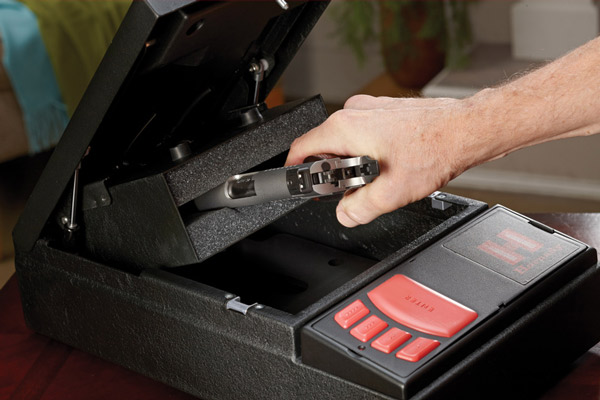
They both live in rural Central Pennsylvania. The topic of conversation when I sat down was rapid opening cases for automatic pistols.  They were discussing the relative merits of biometric locks versus RFID locks. They were talking about the relative merits of the gun case each had put in their bedroom for themselves and also for their wives while they are away from home.

Both men own more than 20 guns which they keep locked in elaborate gun safes.  But the pistol case was for immediate access in case of a home invasion.  Neither man wanted his young children to have any access to the guns, but did want to be ready to defend their homes and for their wives to have access to the gun in a moment.

 So I asked, "Have you or your family ever been threatened or your home robbed?"

Both answered No.

They kept talking about gun cases and their wives proficiency with weapons. Neither of the wives seemed very interested from what I could gather.

Courage in one area does not displace fear in another.  Both of these men happily went to war.  One of them deployed twice, the other at least three times to both Iraq and Afghanistan.  But they genuinely believe their isolated, rural homes west of the Susquehanna in the middle of Pennsylvania must be defended with high-tech weaponry.  By their own admission, they are defending themselves and their homes from a threat that they have never seen or experienced in their lives.


Saturday, February 25, 2017

Courage and Fear: My Father on Fist Fights and Doctors


The ideal of the courageous person is one who can and will face any threat and pain in any situation with equal grace. That ideal person could go to war, find out they have cancer, or get a root canal with equal and undisturbed equanimity. Senator John Glenn and Major Richard Winters seem the closest to the ideal of hero who is brave in every circumstance.

But most real people don't work that way.

My father was a professional boxer.  Every time he stepped into the ring, he knew he was going to be hurt.  But he climbed between the ropes, raised his hands and got punched by another guy who could hit--hard.  The courage that got him in the ring led him to enlist in the Army and serve through and after World War II.

But he was afraid of doctors and hospitals.  His fear was partly inherited from his Russian-Jewish immigrant parents. For a Jew to enter a Russian hospital in the 19th Century meant they had the most dire illness.

Dad lost that fear of doctors in the last decade of his life when doctors and hospitals became a regular and familiar part of his world. He had a brain tumor removed when he was 66. During the next decade he had colon cancer and related problems, then the kidney cancer that finally took his life at 77. In that last decade of his life he faced surgery and recovery again and again.

On the other hand, there are certainly people who are afraid of nearly everything. Some people are hypochondriac, agoraphobic or so swallowed by fear that they can barely function.  The characters Woody Allen plays are close to the inverse of John Glenn and Dick Winters.

To re-cast a nerd joke:  Courage is non-linear, so is fear.


Michael Shaara’s The Killer Angels is one of the war novels that improves with rereading—not because it grows more comforting, but because ...