Showing posts with label History. Show all posts

Thursday, October 8, 2026

The Square and the Tower by Niall Ferguson--A Review


I am accustomed to thinking of modern life as a world of networks. The internet and social media make networks almost impossible to ignore. But in The Square and the Tower, Niall Ferguson argues that networks are not primarily a modern phenomenon. They have always existed, and understanding them can change the way we understand history.

The title comes from Siena, where the open Piazza del Campo—the square—sits beside the Torre del Mangia—the tower. For Ferguson, they represent two different ways human beings organize themselves: networks and hierarchies. The tower is government, church, army, corporation—the formal structures of authority. The square is the less formal world of friendships, families, intellectual circles, merchants, conspirators, correspondents, revolutionaries, and eventually Facebook.

History, Ferguson asserts, has traditionally been written from the tower. We study kings, presidents, generals, governments, and institutions because hierarchies keep records. Networks are harder to see. Yet again and again, networks have changed the world.

Ferguson ranges enormously widely, from the Renaissance and Reformation through the Enlightenment, revolutionary movements, the Rothschild banking network, imperialism, the world wars, the Cold War, and Silicon Valley. Martin Luther did not simply challenge the Catholic Church; his ideas spread through a network made vastly more powerful by the printing press. Revolutionary movements depended upon networks. Financial power depended upon them. So did scientific and intellectual revolutions.

One of Ferguson's most useful ideas is the importance of the highly connected person—the node through which an extraordinary number of relationships pass. Some people matter historically not simply because of their formal position but because they connect people who otherwise would not be connected. 

C.S. Lewis says this brilliantly in his essay "The Inner Ring." He opens the essay with a passage from Leo Tolstoy's War and Peace showing a purple-faced general waiting on a mere captain who was part of an exclusive network.

Power can come from where you stand in a network as much as from where you stand in a hierarchy. That idea immediately made me think of Phillips Payson O'Brien's The Strategists and his portraits of Hitler, Mussolini, Stalin, Churchill, and Franklin Roosevelt.

Seen through Ferguson's lens, their networks provide an interesting measure of their effectiveness. Hitler and Mussolini created powerful and hateful fascist networks that helped carry them to power. But power increasingly isolated them. Hitler ended in his bunker, surrounded by a shrinking circle while the state and military he commanded collapsed around him. Mussolini similarly lost the network that had sustained him and died violently at the hands of his own countrymen.

Stalin is more complicated. He rose through networks as well as the Communist hierarchy, but his paranoia repeatedly destroyed the human connections around him. He managed during the existential crisis of the German invasion to restrain some of that paranoia and listen to capable military commanders. The Soviet Union survived and eventually defeated Nazi Germany. Afterward, Stalin again descended into increasingly poisonous suspicion and isolation.

Churchill and Roosevelt were the opposite. Both were extraordinary networkers. They cultivated politicians, military leaders, journalists, advisers, friends, and correspondents across decades. During the war they became principal nodes in each other's networks. Their correspondence and personal meetings created a relationship that connected two enormous political and military systems. Roosevelt died in 1945, widely beloved, just before victory in Europe. Churchill lived another twenty years and died one of the most revered figures of the century.

Networks certainly do not explain everything about those five men or the outcome of the Second World War. But Ferguson gave me another way of looking at O'Brien's portraits. The ability to create networks may help people acquire power; the ability to maintain them may help determine how effectively they use it.

That is what I liked most about The Square and the Tower. Ferguson did not merely give me another history. He gave me another way of looking at history.  And those are the history books I value most.


Sunday, August 30, 2026

The WEIRDest People in the World by Joseph Henrich


Joseph Henrich’s The WEIRDest People in the World: How the West Became Psychologically Peculiar and Particularly Prosperous is an enormous, ambitious attempt to explain something that social scientists have often taken for granted: people in modern Western societies are psychologically unusual.

WEIRD stands for Western, Educated, Industrialized, Rich and Democratic. Henrich, an anthropologist and evolutionary biologist, argues that WEIRD people differ measurably from much of humanity in the ways they think, reason, cooperate, marry, trust strangers and understand themselves. We tend to be more individualistic, analytical and impersonal. We are unusually willing to cooperate with strangers and join organizations composed of people to whom we are not related. We put considerable faith in abstract principles, rules and institutions.

Henrich argues that these differences are not merely superficial cultural habits. Culture changes people. Literacy, education, occupations and social organization can alter cognition and even aspects of brain development and physiology. Human beings are products of biological evolution, but we are also products of cultural evolution, and the two processes interact.

The book immediately reminded me of Ian Morris’s Why the West Rules—For Now and Niall Ferguson’s Civilization. Both attempt to explain the extraordinary rise of Western societies. Jared Diamond and Yuval Noah Harari have approached related questions on an even larger historical scale. Henrich’s answer, however, surprised me because the institution at the center of his explanation is one that I had never encountered in those other accounts: the medieval Catholic Church.

More precisely, Henrich emphasizes what he calls the Church’s Marriage and Family Program.

Beginning in late antiquity and accelerating through the Middle Ages, the Western Church progressively prohibited practices that had bound people into large kinship networks. Most important was its increasingly aggressive prohibition of marriage between relatives, including cousins and eventually even surprisingly distant relatives. The Church also discouraged polygyny, arranged marriages, adoption and other practices that strengthened clans and extended families.

None of this was intended to create modern Western civilization.

Yet Henrich argues that the unintended consequences were revolutionary.

For most of human history, kinship was among the most important organizing principles of society. People depended upon extended families and clans for protection, marriage, economic opportunity and social identity. Trust was concentrated among relatives. Property and inheritance reinforced family networks. Marriage created alliances between kin groups.

The Church gradually weakened that system in Western Europe.

As cousin marriage declined, extended kin networks fragmented. Households became smaller and increasingly centered on the nuclear family. People became more geographically and socially mobile. A person could no longer depend exclusively upon cousins, uncles, brothers and clan members. Increasingly, individuals had to form relationships with unrelated people.

Out of that transformation came one of Henrich’s most important insights: when kinship weakened, voluntary associations grew.

Guilds, monasteries, universities, religious orders, chartered towns, professional organizations and eventually commercial corporations brought unrelated people together around shared purposes. Cooperation increasingly depended not upon blood but upon rules, contracts, reputation and trust.

This is where Henrich’s psychological argument becomes particularly powerful. Institutions did not simply change because Western people thought differently. Western people came to think differently because they spent generations living within different institutions.

The causal arrow runs both ways.

People accustomed to dealing with strangers become more comfortable trusting strangers. People living under impersonal rules become more inclined to apply universal standards. People freed from dense kinship obligations become more individualistic. They increasingly understand themselves through personal characteristics, occupations, beliefs and accomplishments rather than primarily through family relationships.

Over centuries, Henrich argues, these changes helped produce the extraordinarily peculiar psychology we now call WEIRD.

The consequences multiplied.

Greater individualism encouraged geographic mobility. Impersonal trust facilitated commerce. Voluntary organizations allowed people to cooperate on increasingly large scales. Universities brought scholars together outside kinship structures. Guilds organized craftsmen. Trading companies joined investors who might not even know one another personally.

Eventually the same psychological tendencies contributed to political and intellectual transformations.

The Reformation intensified individual engagement with scripture and literacy. Protestantism encouraged reading, schooling and personal religious responsibility. The Enlightenment pushed universal principles and individual reason still further. Modern science, representative government and market economies flourished within societies increasingly organized around individuals and impersonal institutions rather than clans.

Henrich is careful not to claim that the Catholic Church planned any of this. That is precisely what makes his argument so fascinating.

The Church did not prohibit cousin marriage in order to create capitalism, universities, liberal democracy or the scientific revolution. Medieval bishops were not designing the Enlightenment. Cultural evolution produces enormous unintended consequences. A set of religious rules concerning marriage and family gradually changed social organization; social organization changed psychology; psychological changes encouraged new institutions; and those institutions further changed the people living within them.

It is an extraordinary feedback loop.

Henrich also undermines a mistake that Western researchers have repeatedly made. Psychology has often studied American and European university students and then treated the resulting conclusions as statements about universal human nature. But if Henrich is correct, these research subjects belong to one of the most psychologically unusual populations on Earth. What psychologists thought was simply “human” behavior was sometimes WEIRD behavior.

That alone makes this an important book.

But reading The WEIRDest People in the World also made me think repeatedly about the fragility of the institutions Henrich describes.

One of the great achievements of WEIRD societies has been the development of institutions intended to operate independently of family and clan. Universities, courts, corporations, civil services and democratic governments work best when positions are filled according to competence and rules rather than kinship or personal loyalty. The ideal is imperfectly realized, of course, but the principle itself represents a remarkable historical departure.

That makes the current erosion of institutional norms in the United States particularly disturbing to me. The current President promotes family members, personal loyalists and toadies. Those selected previously for independence or competence have been dismissed. Viewed through Henrich’s argument, it resembles a retreat from one of the distinctive achievements of the long cultural evolution he describes: the replacement of kinship and personal allegiance by impersonal institutions. Henrich talks about the different trajectory and wealth of Northern Italy and Sicily.  The former is WEIRD and successful. The later is poor and dominated by gangsters.  Trump is dragging the US into mobster government.

History is full of rulers who trusted relatives and loyal dependents precisely because independent institutions threatened their power. Liberal societies attempted something much harder: institutions whose legitimacy did not depend upon personal loyalty to the ruler.

Henrich therefore left me with an unexpected appreciation for how historically unusual—and potentially fragile—our civilization is.

Morris explains much about geography and social development. Ferguson identifies institutions that helped Western civilization achieve extraordinary global power. Diamond emphasizes geography, domesticable plants and animals, disease and technology. Henrich goes somewhere different. He asks what centuries of institutional change actually did to the people themselves.

The West did not simply acquire different technologies and institutions. Over many centuries, Western societies produced people psychologically adapted to a world of strangers, voluntary associations, impersonal rules and individual choice. Those people then created institutions that reinforced those characteristics in succeeding generations.

The process was neither planned nor inevitable.

That may be the most important lesson of The WEIRDest People in the World. What cultural evolution created, cultural evolution can presumably change again.

After finishing this remarkable book, I found myself looking differently at institutions I had previously taken for granted. Universities, professional organizations, independent courts, corporations and representative governments are not simply fixtures of modern life. They are products of an extraordinarily long and improbable historical development.

Henrich has written a book about why Western people became WEIRD.

He also, perhaps unintentionally, reminds us how much work it took to become that way—and how unwise it would be to assume that we must remain so.


Friday, March 13, 2026

Geography, War, and Power: Ian Morris’s Grand Argument


Across Why the West Rules, for Now, War! What Is It Good For?, and Geography Is Destiny, historian Ian Morris advances one of the most ambitious arguments in contemporary historical writing: geography shapes human possibilities; war accelerates political organization; and power flows toward regions best positioned to exploit both.

Each book stands alone. Together, they form a coherent trilogy about how civilizations rise, dominate, and eventually yield.

1. Why the West Rules, for Now

In Why the West Rules, for Now, Morris asks the question that animates much global history: why did Western Europe, rather than China or India, come to dominate the modern world? His answer rejects racial or cultural superiority. Instead, he proposes a measurable index of “social development,” tracking energy capture, organization, information technology, and war-making capacity over 15,000 years.

The core claim: geography determines which societies have access to the resources, domesticable plants and animals, navigable waterways, and communication networks that allow complexity to scale. For centuries, China led. Then Europe’s fragmented geography and Atlantic position created competitive pressures and maritime advantages that propelled it forward. Western dominance, in Morris’s telling, is neither destiny nor virtue. It is a phase.

The “for now” matters. The title already anticipates decline.

2. War! What Is It Good For?

If Why the West Rules maps long-term development, War! tackles a more uncomfortable thesis: large-scale warfare has historically made societies safer.

Morris does not romanticize violence. He argues that throughout history, bigger and bloodier wars have tended to create larger political units — empires and states — that suppress smaller-scale violence. The Roman Empire, the Qin and Han dynasties, early modern European state formation — all demonstrate that consolidation through war reduces the frequency of everyday killing.

The modern world’s relative safety, he suggests, rests on centuries of brutal state-building. War is not good in itself. It is good at forcing cooperation and creating Leviathans capable of imposing order.

Read alongside Why the West Rules, the logic tightens: geography creates opportunities; competition turns violent; war builds larger structures; those structures increase social development.

3. Geography Is Destiny

In Geography Is Destiny, Morris narrows his focus to Britain. The book is smaller in geographic scope but just as sweeping chronologically. Here he tests his thesis against a single case: the United Kingdom.

Britain’s island geography, he argues, made it simultaneously European and separate from Europe. The English Channel fostered political independence while proximity guaranteed entanglement. Over 8,000 years, Britain oscillated between integration and distance. Brexit, in this framework, is not a rupture but a recurring pattern.

Morris invokes what he calls “Thatcher’s Law”: Britain is part of Europe, like it or not. Geography constrains identity politics. The island does not move.

The book also revisits themes from his earlier works. Britain’s imperial ascent stemmed from geographic advantages in Atlantic trade and naval projection. Its imperial collapse followed the massive costs of industrialized war in the twentieth century. Geography enabled empire; geopolitics destroyed it.

But the final move of Geography Is Destiny expands outward. Morris argues that Brexit debates miss the larger transformation underway. The real structural shift is the rise of China. Just as Why the West Rules suggested Western dominance was temporary, Geography Is Destiny hints that the world’s center of gravity is moving back toward East Asia. China calling itself the “Middle Kingdom” is not mere poetry; it reflects long-term civilizational centrality.

The Through-Line

Taken together, the three books make a disciplined argument against short-term thinking.

  • Geography shapes opportunity.

  • Competition produces war.

  • War builds states.

  • States dominate until geography and development shift advantage elsewhere.

Morris consistently refuses cultural triumphalism. Western dominance was contingent, not permanent. Britain’s imperial power was structural, not eternal. China’s resurgence may represent reversion rather than revolution.

What makes Morris compelling is scale. He is not distracted by electoral cycles or policy squabbles. He looks at millennia. That long view is unsettling. It suggests that national debates — over Brexit, NATO, American decline — are ripples atop tectonic plates.

If Why the West Rules explains how the West rose, and War! explains the violent machinery behind state power, Geography Is Destiny asks what happens when geography shifts the balance again.

The trilogy leaves readers with a sobering possibility: the West’s “for now” may be ending, not because of moral failure alone, but because geography and development are rebalancing the world.

Morris does not celebrate this. He simply traces it.

That clarity — unsentimental, structural, and expansive — is what makes his work so compelling.


Tuesday, March 10, 2026

Women in Their Element: Selected Women’s Contributions to the Periodic System by Annette Lykknes and Brigitte Van Tiggelen (Editors)


The periodic table is often presented as a clean grid of discovery—elements appearing one by one through the insight of famous chemists. Yet the real history of chemical discovery is far more complex, collaborative, and human. Women in Their Element: Selected Women’s Contributions to the Periodic System brings that complexity vividly to life. Edited by Annette Lykknes and Brigitte Van Tiggelen, the book is both a scholarly reference and an engaging collection of stories about the women who helped build modern chemistry—sometimes celebrated, often overlooked.

Rather than presenting a simple chronological list of discoveries, the editors organize the book around themes that shaped the development of the periodic system. This structure works especially well. It allows readers to see how discoveries emerged not only from individual insight but also from evolving scientific fields such as radioactivity, spectroscopy, analytical chemistry, and instrument development. By grouping the chapters around these themes, the book shows how scientific progress unfolds through networks of researchers, laboratories, and technologies.

The most famous figure in the book is, of course, Marie Curie, whose work on polonium and radium stands among the most important discoveries in modern science. Yet one of the book’s great strengths is that it moves well beyond familiar names. Readers encounter a wide range of women who contributed to identifying, isolating, measuring, or characterizing elements. Some were collaborators whose work was overshadowed by male colleagues. Others were pioneers in laboratory techniques or instrumentation that made later discoveries possible.

In many cases these women worked under conditions that limited their formal recognition. Scientific institutions in the nineteenth and early twentieth centuries often barred women from academic positions, societies, and prizes. As a result, their contributions frequently appeared under the names of male supervisors or collaborators. Women in Their Element does not simply seek to “correct” the historical record by adding forgotten names; it demonstrates how scientific discovery itself is collective. Element discovery often depended on teams, assistants, and technical specialists whose work rarely appeared in headlines.

One of the pleasures of the book is its attention to the practical side of chemistry. The discovery of new elements was not only a matter of theoretical insight but also of laboratory skill and technological innovation. Instruments for detecting radioactivity, methods for separating rare earth elements, and improved analytical techniques all played decisive roles. By highlighting the women involved in developing these tools, the book expands the definition of what counts as scientific discovery.

Another delightful feature is the book’s extensive index of elements. Readers can trace where particular elements appear in the narrative, including historical placeholder names such as “eka-boron” or “eka-tantalum”—the temporary predictions used by Dmitri Mendeleev before those elements were actually discovered. The index even acknowledges the older philosophical “elements” of Aristotle—earth, air, fire, and water—reminding readers that the search for fundamental substances stretches back long before modern chemistry.

The time span of the book is impressive. The story begins in the early modern scientific world of the seventeenth century and continues through the twentieth century into the present. Along the way readers encounter changing laboratory practices, evolving theoretical frameworks, and the gradual expansion of opportunities for women in science. This long view makes clear that the history of the periodic system is not a closed chapter but an ongoing scientific project.

What makes Women in Their Element particularly satisfying is that it works on two levels. It serves as a reference work for historians of science and chemists interested in the development of their field. At the same time, it reads easily as a collection of narratives about persistence, ingenuity, and intellectual curiosity. The individual stories are engaging in their own right, yet together they form a broader picture of how the periodic table came to be.

For readers interested in chemistry, scientific history, or the hidden contributors to major discoveries, this book is both informative and enjoyable. It reminds us that the periodic table—one of the most iconic images in science—was not built by a handful of famous names alone. It emerged from the work of many minds, many laboratories, and many lives devoted to understanding the elements of the natural world.


Tuesday, January 27, 2026

Twelve Windows into History: A Year of Reading History Books in 2025


In 2025, twelve of the fifty books I read were histories. Together they spanned continents, centuries, ideologies, and genres. Some were sweeping narratives of empires and revolutions, others intimate studies of lives, cities, and ideas. The authors ranged from Renaissance philosophers to contemporary journalists. Looking back on this collection now, I’m struck by both its variety and a quiet cohesion: these books are not just about the past, but about how societies contend with power, trauma, and the contested meanings of freedom.

Power and Its Discontents

John Cassidy’s Capitalism and Its Critics serves as a perfect starting point. It’s a clear-eyed survey of the evolution of economic thought and the ideological clashes that surround capitalism. Cassidy isn’t polemical; he’s analytical, tracing how thinkers from Keynes to Hayek shaped (and responded to) the 20th-century world. His book provides essential context for understanding how capitalist democracies weather crises, and how criticism from both the left and the right forms an inevitable—sometimes healthy—part of the system.

Cassidy’s exploration finds a natural companion in Civilization and Colossus, both by Niall Ferguson. In Civilization, Ferguson argues that the West’s dominance was no accident: it emerged from what he calls “killer applications”—competition, science, the rule of law, medicine, consumerism, and work ethic. Colossus extends the conversation to American power specifically, casting the U.S. as an “empire in denial”—reluctant to assume the burdens of imperial responsibility, yet deeply embedded in global dominance. Taken together, Ferguson’s books present a provocative, often contrarian account of empire and modernization.

This theme—how power is structured, sustained, and eventually strained—runs through many of the books I read. Winston Churchill’s The Great Democracies, the final volume in his History of the English-Speaking Peoples, revisits the rise of Britain and America with an unmistakable mid-20th-century tone of civilizational pride. Though his prose is magisterial, the world he writes about—the Anglo-American ascension—is already under siege by the time he sets his pen down.

War, Destruction, and the Edge of Civilization

Where Churchill evokes the glory of democratic power, W.G. Sebald’s On the Natural History of Destruction is a quiet but devastating meditation on the moral toll of war. Focused on the Allied bombings of German cities during World War II, Sebald probes the silence in postwar German literature about civilian suffering. His prose, full of melancholic restraint, contrasts sharply with Ferguson’s triumphalism or Churchill’s rhetorical grandeur. If Ferguson describes the machinery of empire, Sebald offers a view from the ruins.


Sebastian Junger’s War and A Death in Belmont continue this investigation into conflict, though from very different vantage points. War is immersive and immediate—a journalistic account of U.S. soldiers in Afghanistan’s Korengal Valley, one of the most dangerous postings of the post-9/11 era. Junger, embedded with the troops, captures not only combat but the paradoxical camaraderie that war breeds. In A Death in Belmont, he shifts to the domestic front, using a murder case from the 1960s to explore race, violence, and the lingering legacy of fear during the Boston Strangler era. The unspoken thread linking these two books is trauma—how it is felt, interpreted, and often mythologized.

William Stevenson’s A Man Called Intrepid is another account of war—this time from the shadows. The biography of William Stephenson, the Canadian spymaster who ran British intelligence in the Western Hemisphere during WWII, reads like a spy thriller. But it also documents how information, disinformation, and covert alliances shaped the outcome of global war. It’s hard to read this without seeing the roots of today’s surveillance state.

Democracy, Dissent, and Collapse

Two books on this list—Douglas Murray’s On Democracies and Death Cults and Niccolò Machiavelli’s Discourses on Livy—couldn’t be more different in tone, yet both are preoccupied with the fragility of republics. Murray critiques contemporary Western democracies for what he sees as cultural self-sabotage. His essays burn with polemical urgency, questioning whether liberal societies can survive their own internal contradictions. Machiavelli, writing five centuries earlier, is colder, more analytical. His Discourses praise the Roman Republic for its civic virtues, while warning that corruption, inertia, and factionalism inevitably bring down even the best regimes.

If Machiavelli diagnoses decline as a structural reality, Murray sees it as a moral collapse. Together, they ask hard questions about whether democracy is a stable end state or a fragile experiment that must be constantly renewed—and defended.

Lives in Context: Biography and Human Resilience

Several books focus less on systems and more on individuals. Dava Sobel’s The Elements of Marie Curie offers a lucid, engaging portrait of the pioneering scientist. What makes this book memorable isn’t just the science—it’s the clarity with which Sobel evokes Curie’s grit, intelligence, and solitude. In a world dominated by male institutions and fragile egos, Curie carved out a space not only to survive, but to transform science itself.

Jeffrey Rosen’s The Pursuit of Happiness is similarly intimate, though more philosophical. Drawing on American legal and political history, Rosen traces how the idea of “happiness” evolved from classical virtue to individual fulfillment. His book acts as a bridge between past and present, asking how the Founders’ conception of liberty and purpose translates into modern life.

Finally, Simon Sebag Montefiore’s Jerusalem and Titans of History offer sweeping panoramas of world history. Jerusalem is particularly compelling—a biography of a city that has witnessed more religious passion, conquest, and tragedy than perhaps any other. Montefiore manages to narrate this without reducing it to caricature. In Titans of History, he zooms out even further, offering biographical sketches of major historical figures from Hammurabi to Mandela. While more breezy and episodic, it reminds the reader that history is always the product of human choices—often flawed, sometimes visionary.

A Common Thread: Civilization Under Pressure

So what ties these twelve books together? At first glance, they range widely in subject and style. But read as a group, they seem to revolve around a core tension: how civilizations are built, how they are sustained, and how they fracture—through war, ideology, apathy, or internal contradiction.

Whether the topic is Machiavelli’s Ancient Rome, Churchill’s Britain, Sebald’s Germany, or Montefiore’s Jerusalem, the recurring question is this: how do societies balance power with principle, stability with freedom, and tradition with change? These books don’t offer easy answers. Some, like Ferguson or Murray, offer prescriptive warnings. Others, like Sebald or Junger, linger in the ambiguity and pain of aftermath.

Yet taken together, they offer something else: perspective. They show that history isn’t a neat progression or a morality tale. It’s a living, breathing record of decisions made under pressure. And reading these works in 2025—a time of rising authoritarianism, cultural anxiety, and digital fragmentation—I was reminded that history’s greatest lesson may be its refusal to simplify.


Sunday, February 20, 2022

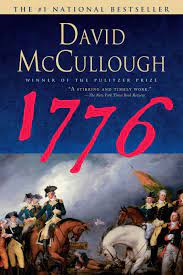
1776 by David McCullough: Book 9 of 2022


I bought this book more than a year ago. A friend who teaches literature said he has read this book every couple of years for more than a decade.  He has read several books by David McCullough and 1776 is his favorite.  

I just finished a biography of Thomas Jefferson and decided now was the time to read about the most fateful year in American history.  The book is even better than my friend Ray led me to believe.  The story is riveting from end to end, and the end is the best. The drama of the battles for Trenton and Princeton kept me reading intently right to the final paragraph.  

The events of the year provide an arc that would make a good movie script.  The first battle of 1776 is the highest moment for America. The long seige of Boston ends when Washington puts a battery of cannon atop Dorchester Heights in one night without the British knowing what was happening.  In the evening the Heights are empty, in the morning nearly two dozen guns are emplaced behind revetments dragged up the hill by two thousand men.  

Within days the British are on the way to Halifax in defeat.

The triumph is followed by a long string of defeats in late summer in New York ending with the loss of Fort Washington with nearly 3,000 Americans captured. Several times in those campaigns, the British stopped just short of wiping out the American Army. As the year ended the bedraggled Americans were at a small fraction of the strength they started the year with. Lord Howe, the British commander decided to end the campaign and finish Washington off in the spring. 

The year almost ends with the Americans in total defeat. Then the night after Christmas, Washington personally led an attack in a blizzard across the Delaware River. The Americans defeated the 1,500 Hessians in Trenton, killing or capturing a thousand with five hundred fleeing. 

Along with the great drama of the story, is real insight into the character of the leaders, particularly George Washington.  The man who would become the first American President did not do everything right, be he carried himself with dignity in every situation. He was tireless and showed confidence in the worst situations.  And at the very worst times, as in the attack on Trenton, Washington was at the front of the attack and the perilous river crossing.  

The heroes of the story were young men. Washington was the old man of the Army at 44 years old.  Thomas Jefferson was 33 when the Declaration of Independence he wrote was read across the new nation.  Nathaniel Greene, one of Washington's best field commanders was also 33.  Colonel Henry Knox, the hero of the victory in Boston, was 25 when the British fled his guns.  One of his battery captains was Alexander Hamilton who was either 19 or 21 depending on when he was actually born, there is some doubt.  James Madison was 25 in 1776. John Adams who kept the Continental Congress focused on supporting the war had just turned 40.  

The founders of America were young men of great physical courage who fought for an ideal that has become a beacon of democracy to the world.   

In two years, I will re-read this book along with my friend Ray.

First eight books of 2022:


The Life of the Mind
by Hannah Arendt

Civilization: The West and the Rest by Niall Ferguson

How to Fight Anti-Semitism by Bari Weiss

Unflattening by Nick Sousanis

Marie Curie  by Agnieszka Biskup (en francais)

The Next Civil War by Stephen Marche

Fritz Haber, Volume 1 by David Vandermeulen


Friday, February 4, 2022

Book 7 of 2022: Thomas Jefferson: The Art of Power


In a famous toast at a White House dinner in honor of 49 Nobel Prize winners, President John F. Kennedy said, 

“I think this is the most extraordinary collection of talent, of human knowledge, that has ever been gathered together at the White House, with the possible exception of when Thomas Jefferson dined alone.” 

I started this book last year and finished it last week.  I am reading The Federalist Papers along with this biography and have reached Federalist 24. After the insurrection on January 6 of last year, I wanted to read about the beginning of democracy in America as the end of democracy approaches.  

The journey has been delightful.  I knew much more about the Revolutionary War than about the politics that led to the nation founded after that war.  

Most importantly, I now can see how much Thomas Jefferson did to preserve our democracy at its beginning.  It seems strange from this far remove to see the strife in the first years of America.  Jefferson's arch rival in George Washington's cabinet was Alexander Hamilton. Jefferson saw the royalist sympathies of Hamilton and was worried he would lead America into either subservience to the English crown or in establishment of an American monarchy.  

At the moment of America's beginning in 1776, it was Jefferson, age 33, who wrote the first draft of the Declaration of Independence--a document so well and forcefully written it largely survived the debate and editing of the Continental Congress.  Although the most significant passage that did not survive debate was a resolution to end slavery with the founding of the new nation. Jefferson would try again after the war, but once the new Constitution was adopted in 1787, he never again made a serious effort to end slavery.  

Jefferson was the third President of the United States, following Washington and John Adams. Jefferson spent a lot of time in France and saw our relationship with France as crucial to maintaining independence.  In 1803, he knew that Napoleon was striving for dominance in Europe and would be ready part with territory in America. In the greatest land deal in the history of the world, Jefferson made the Louisiana purchase, pushing Congress hard to close the deal before the French changed their minds.  Jefferson acquired the vast territory for four cents per acre, a total of $15 million.  The United States of America immediately stretched to the Pacific Ocean. 

Jefferson was far from perfect, as are we all. Jon Meacham's book is clear on his flaws.  He wrote the words that inspired independence for America, he struggled to keep America from falling into monarchy or tyranny. He led America in a way that set it on a course to remain free, if imperfect. 

During his presidency, Jefferson did everything he could to keep the United States out of war. He believed that when a republic goes to war the forces of tyranny become more dangerous. The history of the Roman Republic said this clearly. The road to eventual tyranny was paved with wars. 

Certainly in the past half century, the line from the lies that kept us in the Vietnam War, followed by the Gulf War leaving Saddam Hussein in power, the War in Afghanistan, and the Iraq War all contributed to America electing a President ready to overthrow the government to stay in power.  

Jefferson kept the forces of monarchy from gaining control in the first years of the new American government.  I hope there is still time to keep those who want to establish a Mar-A-Lago monarchy from taking power.  Jefferson, alone at dinner in the White House, was smart enough to find a way to do that. 

First six books of 2022:

Civilization: The West and the Rest by Niall Ferguson

How to Fight Anti-Semitism by Bari Weiss

Unflattening by Nick Sousanis

Marie Curie  by Agnieszka Biskup (en francais)

The Next Civil War by Stephen Marche

Fritz Haber, Volume 1 by David Vandermeulen


Thursday, February 3, 2022

Book 6 of 2022: Civilization: The West and the Rest by Niall Ferguson


I wrote about this book when I read the first half of it late last year. I finished it and like it even more.   I wrote a post about the book when I had read just the first two chapters. It is here.

In this nearly 400-page book, Ferguson shows how in the past 500 years, Europe and the West went from a plague-infested, stagnant collection of petty warring fiefdoms to domination of the world.  

He makes the case in six chapters, each covering a major reason the West overtook and passed China and the Ottoman Empire: both dominant in the previous 500 years or more.  The chapters:

1. Competition

2. Science

3. Property

4. Medicine

5. Consumption

6. Work

Ferguson looks at the growth and change of each of these areas over the previous five centuries. The final chapter on Work begins with the importance of what is called The Protestant Work Ethic to the rise of the West.  He talks about the role religion played in the rise of the West and in the simultaneous decline of the Asian empires.   

In 1517 Martin Luther started the revolution that split the Christian world. That divide between the Catholic Churches and what came to be known as Protestant Churches led quickly to the freedom that allowed the scientific revolution. That scientific revolution led to the development of medicine. The end of Catholic Church dominance quickly led to the end of the feudal system, to more private property and to the revolutions that would eventually end hereditary monarchy.  

With the end of Church influence in commerce came the end of usury laws. Banking became legitimate. Consumption grew. The economies of the West flourished.

By contrast, China and the Muslim world became more unified and more oppressive in rule and religion. By the 19th Century, all of Asia from the Mediterranean Sea to the Pacific Ocean was under the sway of the West.  

Ferguson chronicles all of the horrors committed by European countries in the Americas and Africa.  He also makes clear how differences in religion and government made such a vast difference in the histories of North and South America.  

I like sweeping histories and this one is very good. I plan to read more of Ferguson in the coming year.  Next I will read his new book Doom: The Politics of Catastrophe.

At the end of Civilization, published in 2011, Ferguson talks about the rise of China and the end of Western dominance.  Doom was published in 2021 with China further ascendant and America falling further into the morass of Trumpism.  I heard Ferguson talk about Doom on the Honestly Podcast with Bari Weiss. He definitely had some gloom to go with his doom. I am looking forward to hearing the details.

First five books of 2022:

How to Fight Anti-Semitism by Bari Weiss

Unflattening by Nick Sousanis

Marie Curie  by Agnieszka Biskup (en francais)

The Next Civil War by Stephen Marche

Fritz Haber, Volume 1 by David Vandermeulen


Monday, January 24, 2022

A Healthy Culture Includes All of its History

The French flag waving in the Arc d'Triomphe de l'Etoile on November 11

Few great cultures have been more self critical than French culture.  When revolution swept France in 1789, they even threw out the seven-day per week calendar. They invented the guillotine in 1791 and used it on their king two years later.  The French people analyze and criticize all of their long history and celebrate the best of French history.

Last year, I was in Paris on November 11. I walked around as close as I could to the Arc d'Triomphe de l'Etoile. I saw French people from kids to people in their 80s watching the celebration of the victory of the France and their allies in World War I.  Napoleon commissioned the Arc in 1806. The design was completed the same year, but it would be three decades later in 1836 before it was completed.  

France has a long a long history of fighting wars at great cost in men and money.  The French celebrate their two millennia of history. The celebrate the great triumphs in World War I and many of Napoleons battles and other wars going back to the Roman Empire.  

The French, much better than America, accept all of their history. I worked for a French petrochemical company in the 1990s.  They thought American anguish over President Bill Clinton was amusing. No one in France is surprised when someone with the ego to stand in front of 300 million people and say "Elect me!" turns out to have some flaws.  

I am currently reading a biography of Thomas Jefferson along with the Federalist Papers.  I plan to read biographies of George Washington and Alexander Hamilton later in the year.  The men who founded America were not perfect, but they were great, mostly very young men, who began a nation with liberty for some in the hope of liberty for all some day.  

Jefferson wrote that the American colonies should end of slavery in the first draft of the Declaration of Independence in 1776. In 1787, Hamilton wrote the Federalist Papers to persuade New York and New England to unite with the South, knowing it would mean a slavery compromise. They did the best they could in founding a new nation. 

We should honor our founders knowing they were not perfect, but strove to bring real equality and freedom into a world of monarchy and despotism.  

What they did began a new nation that would lead the free world for much of the 20th Century. Their ideas held until January 6, 2021, when a petulant monster attempted to steal the election and ended the 240-year tradition of a peaceful transfer of power.


I was in London just before November 11. I got a poppy in London and a blue cornflower in Paris. I wore both on November 11. These little commemorative flowers grew in the devastated landscape where the war was fought. 


France and the United States 200 Years Ago

France in the person of Marquis de Lafayette and the troops he brought to Yorktown are the reason there is an America.  Without the French, America would have been defeated in Virginia and lost the war.  Coming to the aid of America added to the crushing debt France already had. That debt and its effects was one of the major causes of the French Revolution less than a decade later. 

Alexis de Tocqueville came to America and wrote a thousand pages about what he saw, praising self-government and the American spirit while unsparing in his criticism of slavery and the way we treated Native Americans.  His book was a call for change in France as well as the single greatest book written about America.  


Wednesday, January 12, 2022

Book 2 of 2022: Marie Curie--a graphic novel biography in middle-school-level French

(In past years I have written an essay about the books I read in the previous year.  As my list of books gets longer and my memory shorter, I decided to write about the books as I read them rather than 2000+ words at the end of the year.)


In November I visited the Institute Curie near the Sorbonne in Paris.  This book was on the shelf in the tiny bookstore inside the small museum.  I read kids books in French to keep some level of reading comprehension.  This graphic novel gave me a chance to practice French and to remember what I learned about the life of this remarkable scientist.  

I learned a lot about Marie Sklodowska-Curie's life because more than half the book is about her childhood in Poland and struggles to get to France to study physics.  When I read about her previously, it was about her research and life-saving work in World War One.  

After I finished the book, I looked up how many people have won Nobel Prizes:  962 laureates earning a total of 603 prizes (as of 2020).  Just 59 laureates are women and Marie Curie is the first.  

Just four laureates have received two Nobel Prizes:  

Linus Pauling won a chemistry prize and a peace prize.

John Bardeen won the Nobel twice in physics.

Frederick Sanger won two chemistry prizes.

Marie Sklodowska-Curie won the Nobel Prize in physics and in chemistry: the only person to be awarded to Nobel Prizes in two different fields.  She is extraordinary, even among the short list of multiple Nobel laureates.  

If you read French at all, the book is fun to read and not difficult.  

The summary on Goodreads:

Cette biographie de Marie Curie (1867-1934) retrace les principales étapes de son existence : son enfance en Pologne, sa scolarité studieuse et ses études supérieures, son arrivée à Paris, sa rencontre avec Pierre Curie, ses recherches sur le radium et ses découvertes sur les rayons X, l'obtention de ses prix Nobel en 1903 et 1911 et son engagement pendant la Seconde Guerre mondiale.


Thursday, January 6, 2022

January 6, 2021, the End of Democracy in America


Trump horde ending democracy in America

From the beginning of my military service nearly 50 years ago, until the last my last day in the Army in May 2016, I attended dozens of change of command ceremonies. After the flag is passed the new and out-going commanders often make a speech.  Probably one in three of those speeches made a sincere nod to the American tradition of the peaceful transfer of power.  

For the mostly conservative officers taking or relinquishing authority, they linked themselves to a 200-plus year American tradition--a hallmark of American exceptionalism.  

But that ended one year ago today when the 45th President sent a mob to overturn the election he just lost.  The coup d'etat was mere minutes from success.  Hundreds of Trump supporters were screaming to kill Mike Pence.  If they had managed to stop the vote, the election could have been thrown into the House of Representatives. That is the last possible place in which a disputed election can be decided according to the Constitution.  

With one vote per state, Trump would have taken the election.  

All of my adult life I had an implicit belief in progress in America: more rights for more people.  The racist rednecks would recede, I believed.  

With Trump's nomination and election, my belief cracked.  After Charlottesville it was shattered. With January 6, it was gone. The end of democracy was only a matter of when.  

America no longer has a tradition of the peaceful transfer of power.  I voted for Joe Biden and hoped normal order could be restored in America.  One year later, the democratic party is fighting about infrastructure and social programs and has done nothing to fix the electoral count act or secure voting.  The Republicans are running MAGA candidates all over the country to get control of election counting.  How much does voting really matter if the Republicans are in charge of counting.  

In 2016, 63 million Americans voted for a failed casino owner who played a business man on a game show.  In 2020, 74 million Americans watched a lying buffoon for four years and said they would like four more.  The people who claim most publicly to be followers of Jesus (Love your neighbor; Love your enemies; turn the other cheek) worship Trump much more fervently than they follow anything Christ ever said or did. I have read and re-read the New Testament. Few people who have ever lived are less like Jesus than Donald Trump.

January 6, 2021, was a dress rehearsal.  The command performance is three years away. In 2025, there will be no need for a mob to attack.  The criminals will be in the building. They will use the power entrusted to them by the Constitution to end democracy. 

The Roman poet Horace fought to preserve the Republic during the Civil War after Julius Caesar took power and was murdered.  The Republicans lost. Horace was wounded and lost everything.  When he recovered, he knew the Republic was gone, so he made peace with his circumstances and became a poet, living the best life he could. 

I hope to be like Horace, to do my best to preserve the Republic, and when that fails, to protect my family and live as well as possible. 

George Packer at the Hannah Arendt Forum: Rediscovering Solidarity in an Age of Division

George Packer At the 2026 Hannah Arendt Forum at Bard College, journalist and author George Packer presented a personal and provocative exa...